
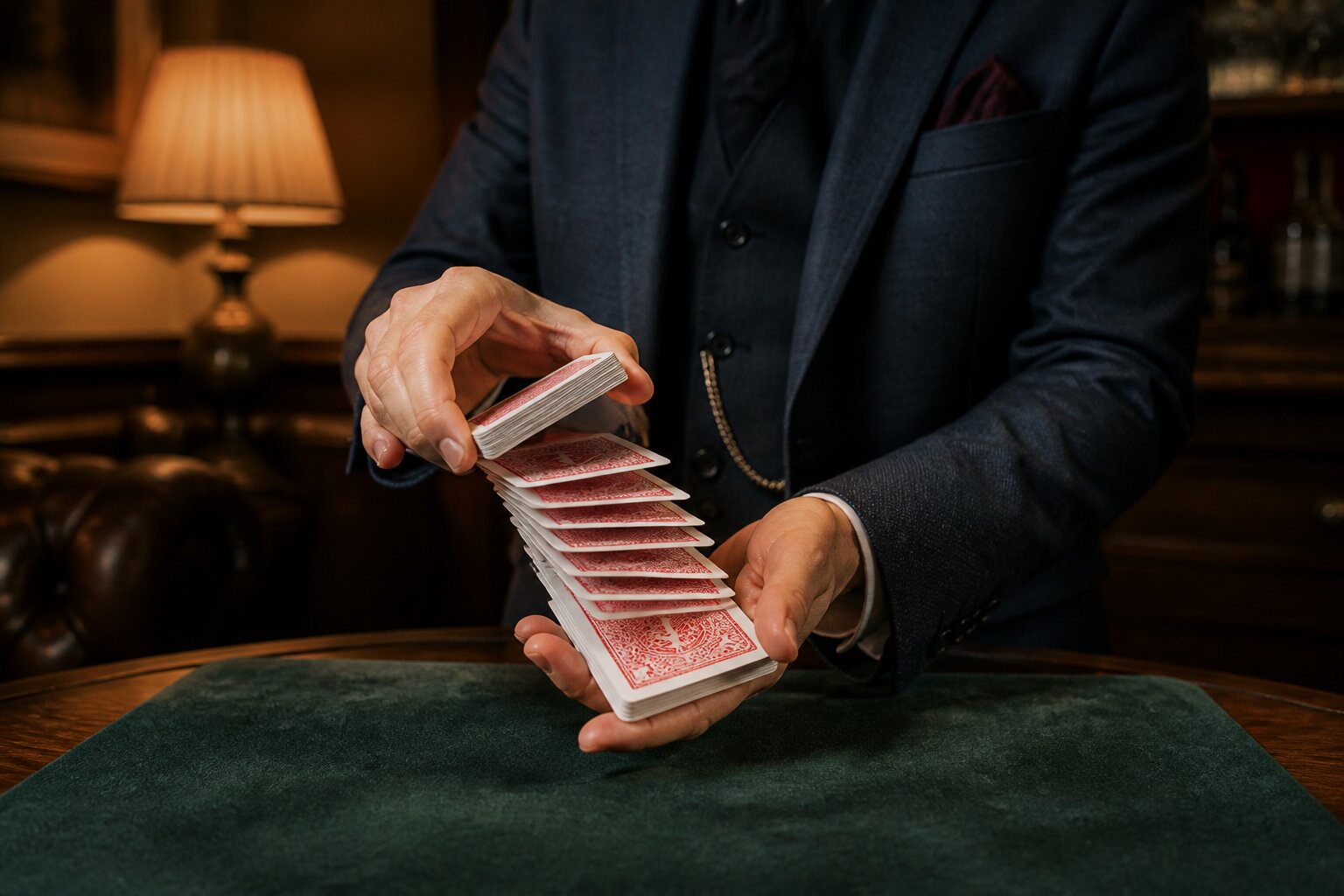
Do you want to wow your friends with lightning-fast hands and stylish flourishes? Learning card shuffle tricks sharpens dexterity and gives you neat ways to entertain at gatherings.
From smooth overhand shuffles to eye-catching springs, sleight of hand and card manipulation turn an ordinary deck into a tool for performance and practise. Ready to pick up tips that professionals use and start building your own routine? Keep going — each section builds on what came before so you can progress naturally.
Why Learn Card Shuffle Tricks?
These tricks are satisfying to learn because they combine physical skill with visual payoff. As you practise, your fingers will gain coordination and your timing will tighten; everyday tasks that need fine motor control often feel easier as a result.
Beyond the personal improvement, card work gives you a simple, portable hobby you can take anywhere. It’s a great conversation starter and an easy way to create a small, memorable moment in social situations. The pleasure comes from the learning curve itself: mastering a move and feeling it click under your fingers.
Finally, working on card techniques teaches patience and attention to detail. Those are useful skills whatever you do next, and they make practising more rewarding.
Essential Tools & Deck Preparation
You don’t need anything fancy — a standard pack of playing cards works best. Beginner decks are stiff and easy to handle; as your skill grows you may prefer more flexible cards designed for flourishes, but starting simple keeps things approachable.
Take care of your deck so practice sessions stay pleasant. Keep the cards clean and replace them when they become warped or sticky; damaged cards frustrate progress and make smooth moves harder. Avoid marked or altered decks — genuine technique should stand on its own.
Keeping the focus on fair performance and honest presentation makes learning more satisfying and keeps your practice suitable for public demonstrations.
How Do You Hold Cards for Maximum Control?
A steady grip is the foundation of every shuffle and flourish. One widely used hold supports the deck in the non-dominant hand so the thumb and fingers form a natural cradle around the long edges; this steadiness lets you deal, riffle or execute a flourish with confidence.
Other holds, like a grip where the dominant hand pinches packets, give you different options for moving small groups of cards. Building a small repertoire of grips lets you adapt to each technique and makes transitions between moves smoother.
Focus on relaxed hands. Tension makes fingers stiff and makes springs or springs-look moves harder to perform consistently.
Popular Card Shuffle Techniques Explained
There are several shuffles that are useful to learn because each produces a different effect and feel. The overhand shuffle is gentle and rhythmic, taking small packets from the top and letting them fall back into place; it’s ideal for building coordination and for routines where subtle control matters.
The riffle shuffle creates that classic interleaving look by joining two halves and letting the corners meet, followed by a bridging motion to square the deck. It looks professional and teaches timing between both hands.
The Hindu shuffle moves cards from one hand to another in short pulls and is often used in magic because it creates a tidy, visual transfer without needing forceful movements. Each technique trains a different aspect of control, and learning a few makes your handling more versatile.
What Is Sleight of Hand & How Can You Practise It?
Sleight of hand refers to refined manual techniques that create convincing visual effects. It’s used by performers to conceal or reveal cards and to add theatricality to a routine. The aim is to surprise and engage an audience through practiced motion rather than gimmicks.
Practising sleight of hand develops concentration and manual precision. Sessions work best when focused on small improvements: a smoother change, a cleaner cover, a more natural gesture. Keep practice intended for entertainment and demonstration; using these moves to gain an unfair advantage in competitive settings is inappropriate and can have serious consequences.
If you want to build a routine, combine moves that naturally flow together so the audience follows the story you’re telling with the cards.
Basic Moves Every Beginner Should Master
Beginners benefit from a handful of reliable moves. The single card lift allows you to isolate one card discreetly, which is useful in many routines. False cuts simulate a deck being mixed while preserving order, lending a professional polish without disrupting controlled sequences.
These basics are the stepping stones for more elaborate work. Once they feel natural, they can be woven into simple effects that entertain without relying on complicated patter.
Advanced Manipulation Techniques for Enthusiasts
Advanced handling introduces moves that demand more finger strength and accuracy. Examples include lifting two cards as one to create a deceptive reveal, concealing a card in the hand during a casual gesture, or producing a dramatic spring that sends cards arching between the hands.
These techniques require repetition to make them appear effortless. As you develop them, focus on naturalness — the trick succeeds when the audience sees a smooth action, not a strained attempt. Practising in front of a mirror or recording your session helps refine angles and timing.
How to Avoid Common Mistakes When Shuffling Cards
New learners often use too much force or grip cards too tightly, which leads to fluttering packets, bent corners, or a deck that won’t sit square. Slowing down and favouring control over speed reduces damage and improves consistency.
Another frequent issue is impatience: switching between too many moves before any become fluent. Concentrating on one element until it feels comfortable avoids sloppy transitions later. If the deck starts to catch or stick, pause and inspect the cards rather than forcing through the motion.
Remember, the goal is clear presentation and steady technique. Avoid moves that could be perceived as deceptive in contexts where fair play is expected; keep performances honest and entertaining.
Are Card Shuffles Just for Magicians?
Card work appeals to a wide range of people. Some enjoy the mental and physical challenge; others like the way flourishes draw attention in social settings. You don’t need a stage or formal training; a small repertoire of tricks and shuffles can make informal gatherings more interesting.
For those who perform publicly, linking moves to short, engaging routines helps maintain audience interest. Keep practicing to refine the gestures that look natural in conversation and take pleasure in the small reactions a well-executed flourish produces.
At the same time, be mindful that using manipulation where it could give an unfair advantage—such as at regulated gaming tables—is not acceptable and risks serious consequences. Keep your practice and performances focused on skill development and entertainment.
Myth-Busting: Can Card Shuffles Change Your Luck?
There’s a common belief that shuffles can influence outcomes. In truth, shuffling is a mechanical process intended to mix cards and make the order unpredictable. The value of practising lies in improving skill and presentation, not altering results.
Poor handling can cause practical issues, such as misdealt hands or damaged cards. These problems are practical consequences of inexperience rather than proof of any change in probability. Practising reduces mistakes, keeps equipment in good condition and makes routines smoother.
Refined technique simply produces cleaner, more convincing effects. Focusing on the following helps performances remain professional and engaging:
- control, so cards behave as you intend
- timing, to create rhythm and anticipation
- angle, to ensure actions are clearly seen by the audience
Concentrating on those elements keeps performances compelling without any claim that shuffles affect outcomes. There is also an ethical dimension: performers should avoid suggesting that particular moves change the chances of a fair game, and should not mislead audiences about randomness.
The real benefit is the craftsmanship of the moves and the pleasure of presenting them well. With practice you gain confidence, consistency and the ability to entertain without implying any alteration of underlying probabilities.
Tips for Mastering Card Manipulation Faster
Progress comes from short, focused practice sessions that emphasise smoothness and repetition rather than trying to rush through every move. Keep sessions brief and regular to build muscle memory without tiring the hands. Use a simple timer or set a clear goal for each session to stay focused.
Observing experienced performers, whether in videos or live workshops, gives clear examples of timing and hand placement to model. Watch slowly at first, then at normal speed, and pick out one detail to copy each time you repeat a move.
Working in front of a mirror or filming yourself highlights small flaws you might not notice otherwise. A mirror helps with posture and hand angles in real time, while recording lets you review timing, rhythm and consistency later. Compare clips over weeks to see subtle improvements.
When practice stalls, change focus to a different technique for a while; varied practise keeps motivation high and helps tie skills together. Rotate through drills that develop different aspects, such as:
- finger dexterity and strength
- control of the deck and card alignment
- timing and rhythm for smooth transitions
Approach learning as a creative pursuit: aim to build a small repertoire of reliable moves that you enjoy performing. Set achievable milestones, celebrate small wins, and gradually combine moves into short routines to boost confidence and performance flow. Remember to rest your hands if they feel tired to avoid strain and maintain steady progress.
Where Can You Find Reliable Resources to Learn More?
There are many legitimate resources for learning card work: instructional books that explain theory and technique, video tutorials showing hands-on angles, and magic clubs or online communities where enthusiasts share tips. Seek sources that emphasise clear demonstrations and responsible performance.
Starting points include beginner-focused guides and community groups that provide feedback; structured practice and constructive critique help accelerate progress. Choose material that matches your pace and that presents techniques you can practise safely and respectfully.
Top Places to Start
You’ll find helpful material in a few different formats that suit various learning styles:
- Online videos showing hand angles and timing from experienced handlers.
- Books that explain the underlying mechanics and offer exercises for steady improvement.
- Local or online clubs where members exchange advice and provide supportive feedback.
Whichever path you choose, keep the emphasis on skill-building and entertaining presentation. With regular practice and patience, you’ll develop techniques that look polished and feel natural to perform.
**The information provided in this blog is intended for educational purposes and should not be construed as betting advice or a guarantee of success. Always gamble responsibly.