
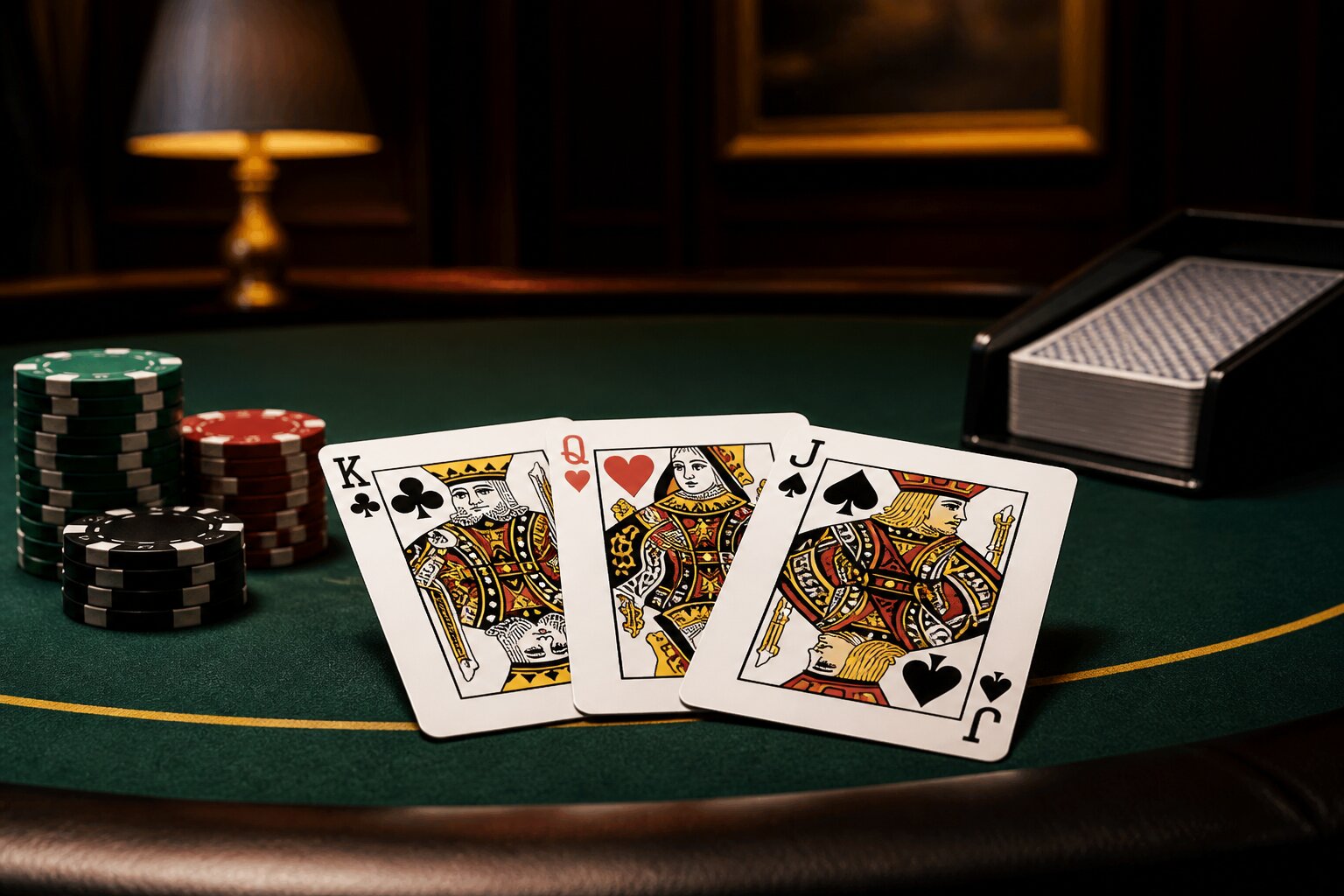
Blackjack can feel straightforward and baffling at the same time, especially when you first learn how cards are scored. Face cards — Kings, Queens and Jacks — look distinctive, but their actual value is simple and hugely important to how the game plays out.
This guide lays out exactly what face cards are worth, how they work with other cards, and how that affects decisions at the table. Read on and you’ll have a clearer picture of the numbers behind the cards and why they matter.
What Are Face Cards in a Deck of Cards?
Face cards are the Jack, Queen and King in each suit. They are called face cards because each one shows the likeness of a person rather than a simple pip or number. With four suits in a standard 52-card deck, there are 12 face cards in total.
The four suits are:
- Hearts
- Diamonds
- Clubs
- Spades
Face cards are often also called court cards. Many modern decks show the Jack, Queen and King as double-headed figures so the picture can be seen right way up from either end of the card. The corner indices still display the rank and suit to make them easy to read in play.
In blackjack and many other card games the face cards all carry the same value. In blackjack they are each worth 10, so they play a consistent role when adding up hand totals. That consistency makes them central to basic strategy and probability calculations in games where card values matter.
Face cards also have different roles in other games. In trick-taking games they may have higher or lower rank depending on the rules, while in poker they are simply high ranked cards that influence hand strength. Across card games, their distinctive appearance and uniform values make them easy to spot and important to understand.
How Are Card Values Assigned in Blackjack?
Blackjack assigns a fixed value to most cards. Number cards count at face value: a 2 is two points, a 7 is seven, and so on up to 10. Face cards — Jack, Queen and King — are each worth 10 points, regardless of suit. Aces are flexible and can count as either 1 or 11, whichever benefits the hand without exceeding 21.
These rules mean a deck contains many 10-value cards: the four 10s plus the 12 face cards. That concentration affects the distribution of totals and the likelihood of certain hands appearing. When you’re assessing a hand, it helps to keep in mind both the fixed values and the Ace’s variable value, because that combination shapes many common scenarios in play.
Why Are Face Cards Important in Blackjack?
Face cards are important because they alter totals in large steps. A single face card changes a hand by 10 points, which can bring a player much closer to 21 or push them over if they are already high. That makes the timing and context of a face card appearing significant.
Because the deck contains so many 10-value cards, the same value appears more often than any other aside from low-number cards. This affects decisions such as whether to take another card or to stand, and it underpins why certain plays are mathematically preferable in standard strategy charts. Face cards also combine with Aces to form the highest-scoring natural hand, which usually carries the best payout.
While outcomes cannot be predicted with certainty, understanding how face cards shift totals helps players make sound choices and manage their play more effectively.
Are Face Cards Treated Differently in Variations of Blackjack?
In most blackjack variants, face cards remain worth 10 points. The core scoring rarely changes even when tables add side bets, bonus payouts or themed rules. Those variations tend to alter payouts or introduce optional wagers, not the fundamental card values.
That said, rule differences elsewhere at the table — for example, whether the dealer hits or stands on a soft 17, how many decks are used, or whether surrender is allowed — can change the practical value of certain hands. So while a face card’s numerical value stays the same, its strategic importance can shift depending on the specific rules in play. It pays to check the rule set at the table before deciding how to play a hand.
Common Misconceptions About Face Card Values
A few persistent misconceptions crop up around face cards. One is the idea that Kings, Queens and Jacks have different values or that suits matter for scoring. In blackjack they do not: all face cards count as 10 points.
Another misconception is that face cards somehow alter your odds in a predictable way. Because card distribution and dealer rules determine outcomes, a face card’s appearance is one element among many and does not guarantee a particular result. Finally, people sometimes look for special tactics tied only to face cards; the rules treat them uniformly, so strategy focuses on totals and the Ace’s flexibility rather than on individual face cards themselves.
Clearing up these misunderstandings makes it easier to apply consistent, rule-based thinking at the table.
Understanding the Impact of Face Cards on Your Hand
Face cards affect hands in a few key ways, and recognising these effects will help you interpret the state of play as it develops.
Raising Your Total Quickly
A face card adds 10 points instantly. When joined with an Ace, that combination yields a natural total that is usually the best hand, because the Ace can flex to 11 and form a 21. In other contexts, adding a face card to a mid-range total can push a player into a risky zone where further hits are likely to bust the hand.
Making Decisions
Decisions about whether to take another card, split, or double down are guided by hand totals and the dealer’s visible card. The prevalence of 10-value cards in the deck influences the calculus behind those choices: certain totals are more likely to be improved or worsened by another draw than others. Players base their moves on these probabilities and rule variations, treating face cards as high-value contributors rather than as special or separate pieces.
If you’d like to think about examples: a player holding a 6 and a Jack has 16, a common bust-prone total where many strategy charts recommend standing against some dealer upcards and hitting against others. That recommendation reflects how a single 10-value card would affect the hand.
Play should always be within personal limits and done with awareness of the risks involved.
This wraps up the essentials about face cards and their role in blackjack, showing how a simple, consistent value can still have wide-ranging strategic effects.
**The information provided in this blog is intended for educational purposes and should not be construed as betting advice or a guarantee of success. Always gamble responsibly.