
Ever found yourself at a blackjack table, unsure how to let the dealer know your next move? Hand signals are an essential part of the game: they make intentions clear and help the table run smoothly.
This guide walks through the standard gestures, how dealers interpret them, common mistakes to avoid and what to keep in mind if you’re joining a game for the first time. Read on and you’ll feel more confident about playing and fitting in at the table.
From the most common gestures to subtle local differences, everything here is written so you can pick up the basics quickly and play with ease.
What Are Blackjack Hand Signals?
Blackjack hand signals are simple, agreed movements used to tell the dealer what you want to do — for example, take another card, keep your current total, or split a pair. They replace spoken instructions so that actions are obvious and unambiguous even when the table is busy.
Because these gestures are visible to the dealer and the table, they create a clear record of your choice in real time. That helps prevent disputes about what was asked for, and it speeds up play by removing the need for repeated clarification. In most casinos it is standard practice to use these signals, and dealers expect them as part of normal table conduct.
Knowing the basics makes joining a game less intimidating and helps the round stay fair for everyone. Next, we’ll cover the most common signals you’ll encounter.
Common Table Gestures & Their Meanings
Below are the gestures you’re most likely to see, with simple descriptions so you can reproduce them confidently at the table. Use these to make your intentions clear to the dealer and other players, and remember that local table rules may vary.
Hit
To request another card, tap the table once near your cards with a finger. The movement should be deliberate but controlled so the dealer can instantly see your intention.
Make sure the tap is clearly visible but not aggressive. If the table is crowded or noisy, catch the dealer’s eye briefly to confirm they have seen you.
Stand
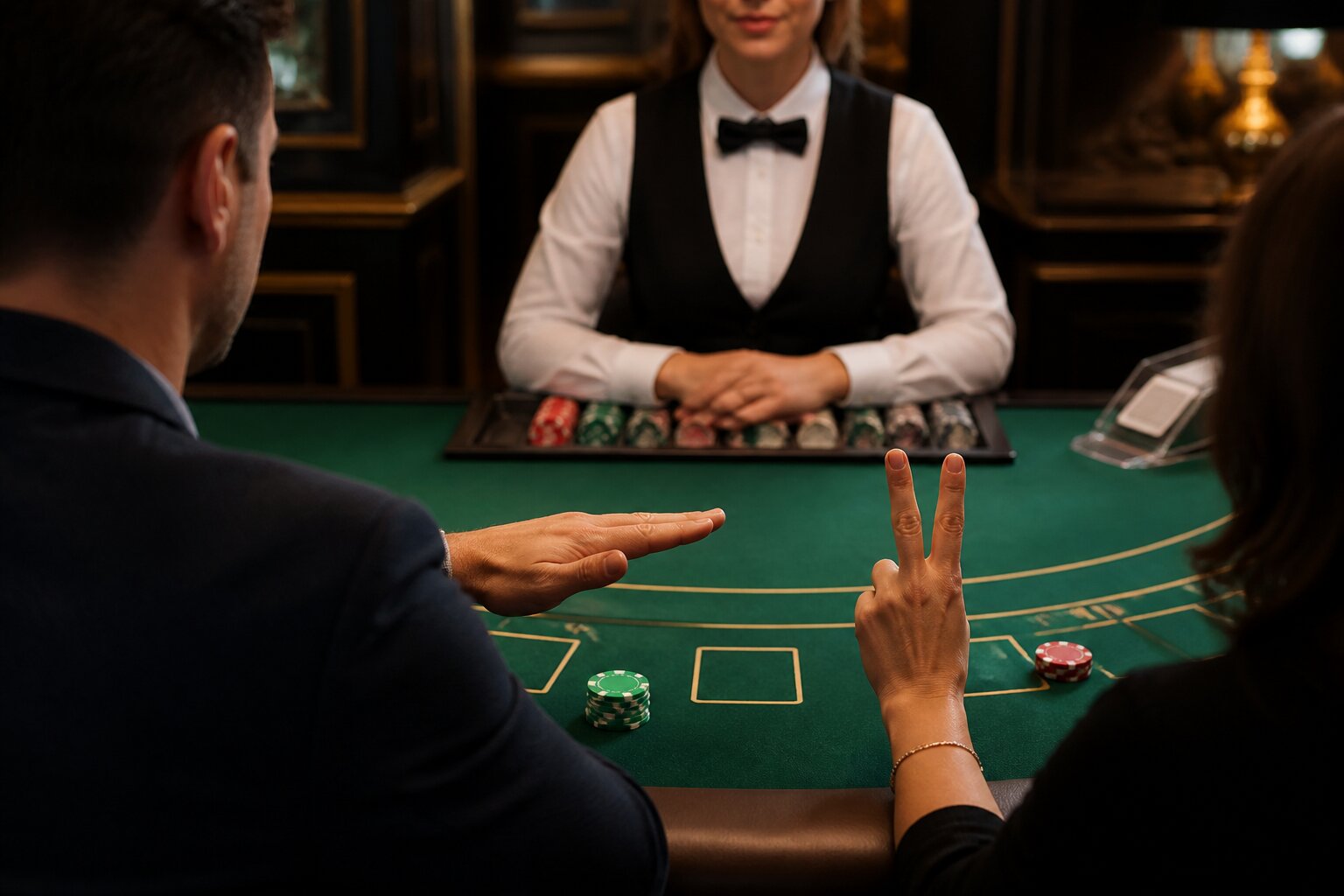
To indicate you want no more cards, wave your hand horizontally over your cards with the palm facing down. Keep your cards on the table while doing this to avoid breaking table procedure.
This gesture should be slow and unmistakable. Do not push your cards into the dealer’s area; simply signal and wait for the dealer to acknowledge.
Double Down
When you want to double your stake and take exactly one more card, place extra chips beside your original bet and gesture by pointing with one finger or tapping the table with two fingers. This shows both the increased wager and the choice to accept a single additional card.
Confirm the extra chips are clearly placed next to your original bet so the dealer can adjust payouts correctly. If you are unsure about available doubles or bet limits, ask the dealer before making the move.
Split
If your first two cards are the same value and you wish to play them as two hands, add the matching bet for the second hand and form a “V” shape with two fingers over your cards. This separates them visually and signals the dealer to treat them as distinct hands.
Place the additional wager beside the original bet and wait for the dealer to separate the cards. Remember that some tables have specific rules about re-splitting and splitting aces, so check the table rules first.
Surrender
Where surrender is offered, indicate it by drawing an imaginary line behind your cards with one finger, as if cutting the table. Doing so shows you want to forfeit half your bet and end the hand.
Surrender is not available at every table, so the dealer may remind you of the option. If offered, use the gesture early in the round and await confirmation from the dealer before collecting or losing the appropriate amount.
These gestures are about clear communication and correct procedure. They do not change the odds of the game, only how clearly your decision is conveyed and handled by the dealer.
How Does Dealer Communication Work?
Dealers are trained to watch for each gesture and to respond immediately so play continues without delay. When a gesture is made, the dealer performs the corresponding action — dealing a card, standing, paying out, collecting, or splitting hands — and does so visibly to the table.
This visual communication reduces the chance of contested calls because it is observable to everyone and can be reviewed if needed. Many casinos also record games on camera, which adds another layer of transparency and helps resolve disputes.
If a gesture is unclear, the dealer will usually confirm before proceeding, but it’s best to be decisive with your movement so there’s no need for clarification. Clear signals keep the action moving and ensure the dealer can apply the rules consistently for all players.
When Do You Use Each Signal in Blackjack?
Each gesture corresponds to a decision point that arises as the cards are dealt and the round plays out. “Hit” is used when a player wants another card, typically when their total is well below 21 and they want to improve it. “Stand” is used when a player is satisfied with their total and prefers not to take further risk.
“Double down” is commonly chosen after the first two cards are dealt if the player wants to increase their bet and take a single additional card. Splitting happens when the initial two cards share the same value and the player opts to play two separate hands. “Surrender” is an early concession to receive half the wager back, where the table rules allow it.
Which choice to make depends on the player’s assessment of their hand and the table rules. Familiarity with the signals lets you express those choices cleanly when the moment arises.
Why Is Proper Etiquette Important in Blackjack?
Using standard hand signals and following table behaviour helps everything run fairly and efficiently. When everyone conforms to the expected gestures and keeps actions visible, the dealer can handle hands quickly and consistently, which benefits all players.
Good etiquette also shows respect for fellow players and staff: keeping conversation low, avoiding unnecessary movements, and not lifting cards off the table are simple ways to prevent disruption. A calm, orderly table reduces mistakes and makes the game more enjoyable for everyone involved.
Adhering to these norms also supports the casino’s duty to provide an orderly environment and ensures the same rules and procedures apply to every player.
Hand Signal Mistakes to Avoid
New players often make a few recurring errors. One is producing vague or hesitant gestures that the dealer cannot interpret at a glance. Another frequent mistake is lifting cards off the table to point at them; most venues require cards to remain on the felt.
Confusion can also arise from mixing gestures — for example, tapping when you mean to stand — so pause briefly to ensure your movement matches your decision. Talking over or alongside gestures can create ambiguity, too, because the dealer relies first on visual signals.
If you’re unsure about a particular gesture, ask the dealer before the round starts. Being clear and consistent helps avoid disputes and keeps the round moving smoothly for everyone.
Do Hand Signals Differ Between UK and International Casinos?
The core gestures for hit, stand, double, split and surrender are used widely, but you may notice small regional differences in how they are executed. In some countries a player might point at their cards for a hit, whereas elsewhere a table tap is preferred. Table layout and local house rules can also affect how wagers and gestures are presented.
If you plan to play in a different venue, take a moment to watch a round or ask staff what the local practice is. That quick familiarisation will make it easier to adapt and avoid inadvertent errors when playing abroad.
Myths About Blackjack Hand Signals
There are a few misunderstandings that circulate among players. One common myth is that using a particular gesture will influence the outcome; gestures only communicate decisions and do not affect the way cards are dealt. Another misconception is that accidental or unfamiliar gestures will automatically result in penalties — in practice, dealers usually seek clarification if something isn’t clear.
Some players imagine secret or complex signals grant an advantage. Casinos use standard, public gestures precisely to keep play transparent and fair; there are no hidden moves that change the rules of the game.
Understanding what hand signals do — and do not do — keeps expectations realistic and helps you focus on playing within the table’s rules.
Tips for First-Time Blackjack Players
If this is your first time, a few simple approaches will make the game more comfortable and respectful for everyone involved.
Observe a few rounds before joining to see how gestures are performed in real time; this provides context for when and how to act. When you do play, slow down and make your gesture clearly so the dealer can see it at once. Learn the basic table rules first, including limits and any special procedures for doubling, splitting or surrendering.
Set a budget you’re comfortable with before you start and use any responsible gambling tools the venue offers if you need them. Staff are there to help with rules or etiquette questions, so do ask if anything is unclear.
With a little observation and calm, you’ll fit in quickly and enjoy the experience without drama.
Final thought: clear, simple gestures keep the game fair and pleasant for everyone at the table, so a small bit of practice goes a long way toward a confident, courteous game.
**The information provided in this blog is intended for educational purposes and should not be construed as betting advice or a guarantee of success. Always gamble responsibly.