
Ever wondered if the dealer in blackjack can split their own cards, just like players do? You’re not alone. Knowing what the dealer can and cannot do helps you follow the action at the table with confidence.
This short guide explains the rules around dealer splits, clears up common misunderstandings, and points out what to expect whether you’re at a casino or playing online.
Read on for a clear, no-nonsense look at how dealer hands are handled and why the rules exist.
Understanding Basic Blackjack Dealer Rules
Dealers follow a fixed set of rules laid down by the casino. Unlike players, they have no discretion: the dealer’s actions are predetermined so each round is consistent and transparent.
Typically, dealers must draw until they reach a total of 17. Where an Ace can be counted as 11, a hand like Ace-6 is called a soft 17; some venues require the dealer to hit on soft 17, while others require the dealer to stand on all 17s. These small differences are set by the house and are visible on the table or in the game rules.
Because the dealer’s moves are automatic, they never make strategic choices based on players’ hands. That structure keeps the dealing procedure straightforward and predictable for everyone involved.
Player vs Dealer: Splitting Rules Compared
Players are allowed to split a pair—turning two cards of the same value into two separate hands, each with its own stake and play. It’s a player decision that adds a tactical layer to the game.
Dealers do not have that option. When a dealer’s first two cards form a pair, they do not split; instead, they continue to play a single hand according to the house rules discussed above. This difference is fundamental to how the game is organised: splitting is a player choice, not a dealer action.
Understanding this contrast helps avoid surprises at the table and makes it easier to read the dealer’s automatic sequence of play.
What Happens If the Dealer Gets a Pair?
It’s fairly common for the dealer to receive two cards of the same value, and casinos treat those pairs the same as any other starting hand. The dealer simply follows the fixed drawing rules—hitting or standing—without creating an extra hand.
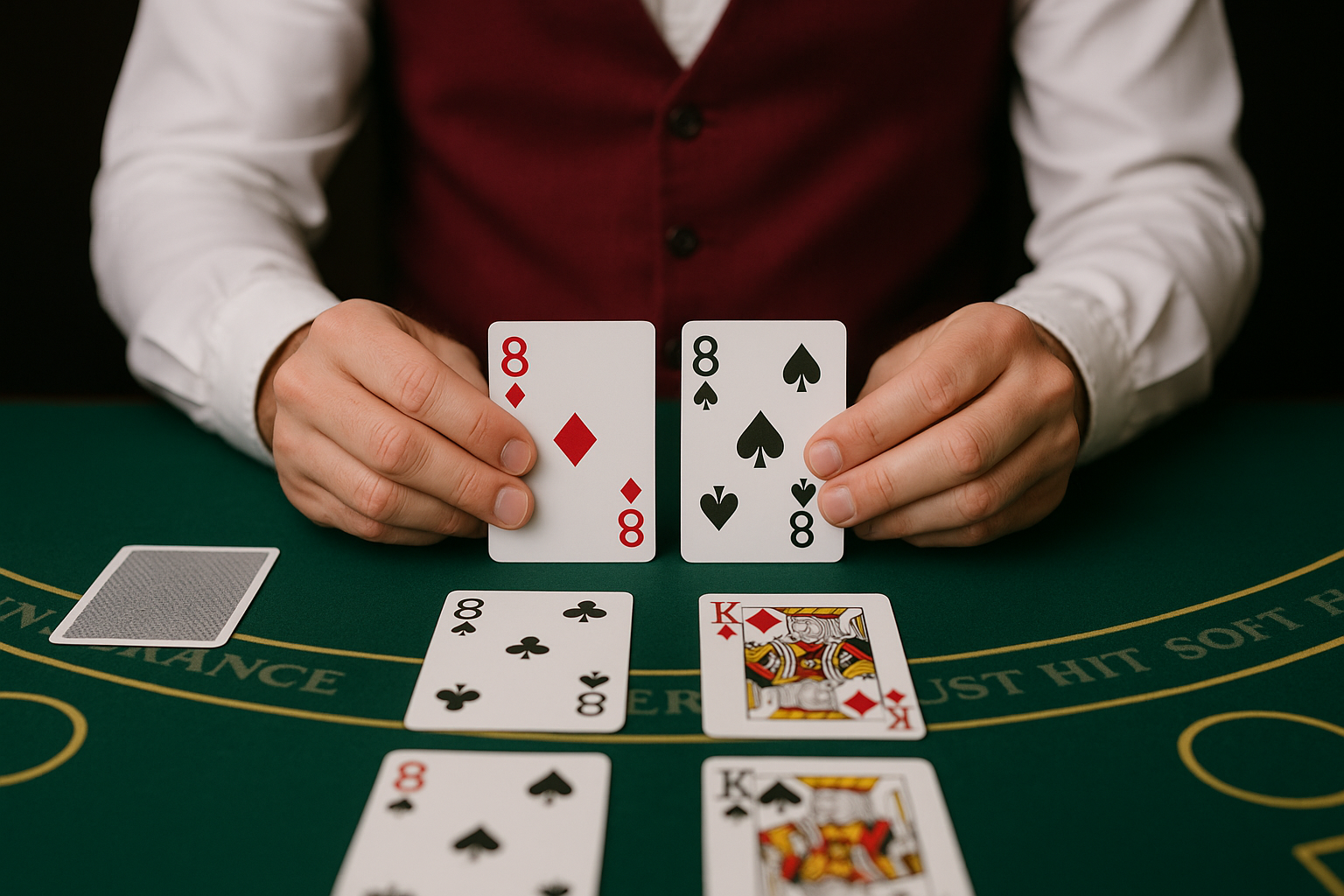
For example, if a dealer shows two eights, those cards remain one hand. The dealer will draw additional cards only as required by the house rule in effect that session. This keeps the dealing process efficient and avoids complications that would arise from the dealer managing multiple hands simultaneously.
If you’ve been wondering whether special treatment applies to dealer pairs, the short answer is no: pairs do not change the dealer’s single-hand obligation.
Are There Any Exceptions to Dealer Splitting Rules?
Across standard blackjack variants you’ll encounter in licensed venues, the dealer is never permitted to split. This is a uniform rule designed to preserve consistent gameplay and avoid unexpected deviations from the established dealing routine.
The ban on dealer splitting also supports clear regulatory oversight and predictable house rules, which helps both players and operators understand how hands will be resolved. It keeps comparisons between games straightforward and prevents novel mechanics from changing fundamental strategy or payout structures.
If you come across a game that claims to allow dealer splitting, it is worth checking the game’s official rules before you play. Look for clear documentation that explains any unusual mechanic, and verify whether the game is offered by a regulated operator and covered by the venue’s published terms.
Keeping these checks in mind helps you set realistic expectations and interpret the rules you see posted at a table or listed in a game lobby. If anything looks unclear, ask staff or review the game provider’s help pages to avoid surprises.
Myths About Dealer Splitting Debunked
A few persistent rumours circulate about dealers splitting, but they don’t hold up under scrutiny. The most common mistaken belief is that a dealer can split in the same way players can; in actual game practice dealers do not split and never take the player’s splitting decision.
Another myth is that alternative or exotic blackjack versions routinely let dealers split. While games can introduce unusual rules, dealer splitting is not a conventional or typical feature and should not be assumed.
Clearing up these misconceptions makes the game easier to follow and keeps table talk grounded in how the game is actually played.
Why Can Only Players Split in Blackjack?
Splitting is part of the set of choices available to players because it introduces a layer of decision-making and risk management into a player’s turn. Allowing only players to split preserves this element of gameplay while keeping the dealer’s role procedural and manageable.
From an operational standpoint, restricting splits to players keeps deals moving and avoids the logistical complications that would arise if dealers started playing multiple hands. It also maintains a clear separation between player strategy and dealer procedure, which helps casinos ensure consistent implementation of the rules.
To sum up, splitting is a deliberate player option that serves the flow and fairness of the game; dealers remain bound to their fixed sequence of actions so each round proceeds smoothly.