
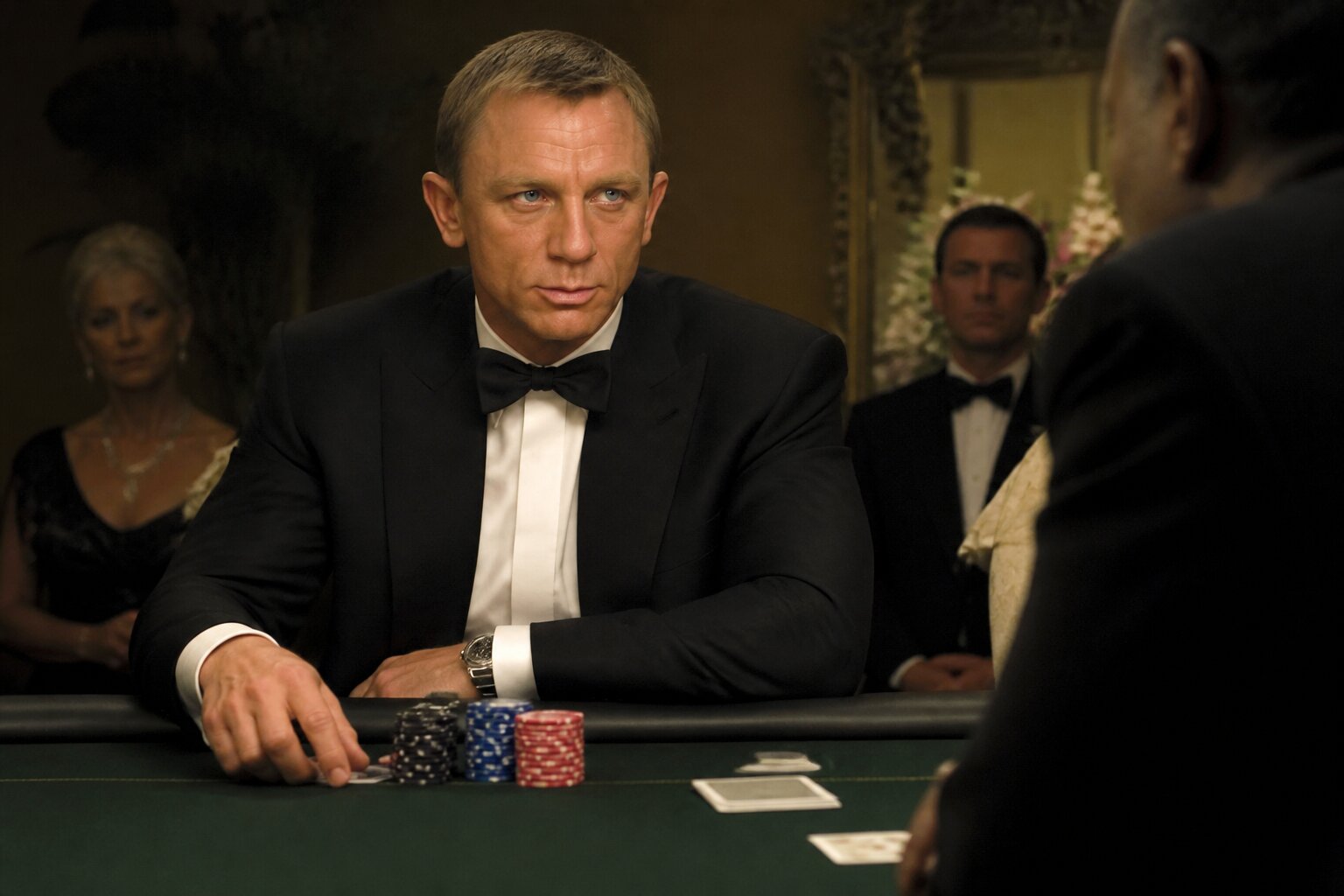
When you picture James Bond in a glamorous casino, do you imagine him shuffling cards at a high-stakes table, cool as ever? The casino scene in Casino Royale is one of the most iconic moments in the franchise, and Bond’s performance at the card table is nearly as famous as his gadgets and cars.
This article explains which game Bond plays, how it works on screen and in the original novel, and why that particular game was chosen for the 2006 film. Along the way you’ll find clear examples and context to make sense of the drama at the table.
What Is the Card Game Played by James Bond in Casino Royale?
In the 2006 film, Bond plays Texas Hold’em Poker. Each player receives two private cards and shares up to five community cards on the table. The aim is to form the strongest five-card hand using any combination of private and community cards, and rounds of betting give this structure dramatic ebb and flow.
Ian Fleming’s original Casino Royale novel features a different game: Chemin de Fer, a form of baccarat. That older version relies on a simpler set of choices and a different rhythm of play, which suited the book’s psychological tension. The film replaced baccarat with Texas Hold’em because poker’s staged reveals and betting patterns translate well to visual storytelling.
That shift from book to screen is central to how the casino sequence works. The next section looks at where Texas Hold’em originated and how it became the game filmmakers chose.
Origins of the Featured Card Game
Texas Hold’em emerged in the United States in the early 20th century, with Robstown, Texas, often cited as its birthplace. The game spread through Texas and onwards to gambling centres such as Las Vegas, where it gained wider exposure in the 1960s and beyond.
A major catalyst for its popularity was the World Series of Poker, established in 1970, which introduced televised coverage and formal tournament structures. Over several decades, Texas Hold’em developed into the most widely recognised poker variant, prized for a balance of probability, psychology and tactical depth.
Understanding its history helps explain why the game felt modern and familiar to audiences in the 2006 film. With that background, it becomes easier to follow how the game is staged and why it creates such tension on screen.
How Is the Game Played?
Texas Hold’em proceeds through a sequence of betting rounds and shared community cards. Play begins with two forced bets known as the small blind and the big blind. Each player receives two private cards, then a round of betting unfolds where players weigh options such as calling, raising or folding.
Three community cards are then revealed together in the flop, prompting a second betting round. A fourth card called the turn follows, then another round of betting. Finally, the river delivers the fifth community card and a final betting round takes place. If multiple players remain, hands are revealed and the best five-card combination wins.
Hand rankings — from high card up to royal flush — determine the winner. The game requires reading opponents, managing bet sizes and adapting to the changing board. This mixture of probability and game theory, along with visible card reveals, is what makes Hold’em well suited to cinematic scenes of confrontation and suspense.
Rules Unique to Casino Royale’s Portrayal
The film presents poker in a way that emphasises drama. Betting sizes, the speed of play, and the scale of stakes are heightened compared with typical casino practice. Certain procedural details are streamlined on screen so the audience can follow pivotal moments without becoming bogged down in table formalities.
In the novel’s Chemin de Fer setting, the focus is tighter on psychological duels and simpler decision points. The movie’s switch to Texas Hold’em lets filmmakers show layers of strategy through visible community cards and staged tension. Some actions in the film, such as rapid reveals or magnified bets, are there to serve narrative impact rather than to reflect exact casino protocol.
These cinematic choices shape the viewer’s experience of the game while still keeping the core mechanics recognisable. Next, we’ll examine the reasons behind selecting Texas Hold’em for the film adaptation.
Why Was This Card Game Chosen for Casino Royale?
The filmmakers chose Texas Hold’em to modernise the story and to make the casino scenes more immediate for contemporary audiences. By the early 2000s poker was familiar from televised tournaments and online play, so the game’s structure and visual moments were easier for viewers to grasp.
Cinematically, Hold’em provides clear beats: pre-flop action, the flop, the turn and the river. Each reveal changes the possibilities at the table and gives actors a reason to react, creating escalating drama. The game also allows for bluffing and strategic betting to become part of character interaction, aligning with Bond’s emphasis on observation and controlled risk.
Swapping baccarat for poker was therefore a practical storytelling choice that preserved the core confrontation of the scene while making it more accessible and tense for a modern audience. Having set out why poker was chosen, the next section considers some common misunderstandings about Bond’s table play.
Common Misconceptions About James Bond’s Card Game
One common error is to assume Bond always plays poker in every casino appearance. In fact, the original novel places him at a baccarat table, while the film adaptation features Texas Hold’em. The different games produce a different pace and psychological texture.
Another misconception is that the film’s poker sequence mirrors everyday casino procedure. Elements like rapid hand resolutions, extremely large stakes and heightened betting rhythms are tailored for drama. Real high-level poker follows stricter protocols and generally moves at a more deliberate pace.
Finally, some viewers take Bond’s on-screen success as proof of a guaranteed method for winning. Outcomes in poker are governed by probability and variance, and even strong strategic choices do not ensure a constant edge. It is sensible to acknowledge those limits and view the film’s portrayal as dramatized fiction rather than instruction in real-world gambling practices.
Cultural Influence of James Bond’s Card Game
Bond’s casino scenes have had a noticeable effect on popular culture. They helped bring poker into mainstream entertainment and associated cardroom imagery with sophistication and psychological contest. The 2006 film in particular exposed a wide audience to Texas Hold’em and reinforced the game’s cinematic potential.
These portrayals have influenced film, television and advertising, where card games are often used to signal tension, skillful bluffing or rivalry. At the same time, Bond’s casino moments remain stylised versions of play, chosen to serve story rather than to recreate everyday gambling environments.
Taken together, the novel and film versions of Casino Royale show how different games can create contrasting dramatic effects, and why the filmmakers selected the version that best served their narrative goals.
**The information provided in this blog is intended for educational purposes and should not be construed as betting advice or a guarantee of success. Always gamble responsibly.