
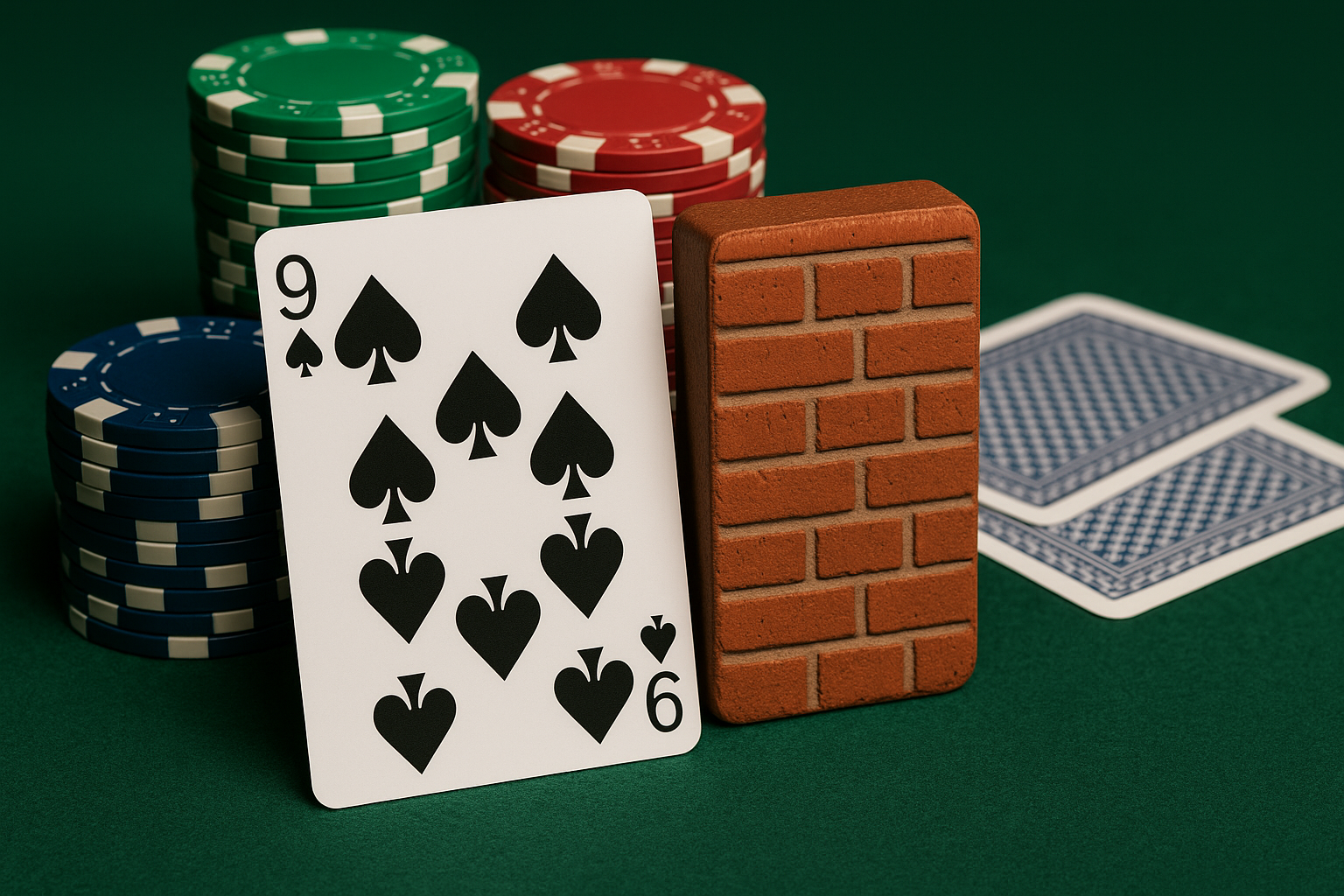
If you’ve ever watched a live poker game or joined an online table, you’ve probably heard players use the word “brick.” It’s a short, sharp piece of slang that tells you a lot about how a hand has just unfolded.
Understanding terms like “brick” helps you follow action more closely and join the conversation at the table with confidence.
This post explains what a brick is, how players use the term, and a few related phrases you’ll hear in poker rooms and broadcasts.
What Does 'Brick' Mean in Poker?
A “brick” is a community card that does not noticeably improve any player’s hand or complete likely draws. The term is most commonly used on the turn or the river in Texas Hold’em, when a card appears that doesn’t change the balance between opposing hands.
Imagine a board that already supports potential straights or flushes, and then a low, off-suit card arrives. Players will often call that card a brick because it fails to help those chasing a draw. In other words, it’s a card that leaves the contest largely as it was before it was dealt.
Whether a particular card is a brick depends on what players hold and what they are trying to make, so the label is contextual rather than absolute.
Understanding Poker Slang: Where Did 'Brick' Originate?
The word comes from everyday language: a brick is solid and unyielding, and in poker it conveys the same idea. A brick is a card that simply sits there without changing the action, offering no help to the players who needed improvement. The image is blunt and immediate, which is why it caught on.
It became common at tables and in commentary because it quickly communicates a specific kind of disappointment or relief, depending on who is speaking. Commentators and players can say one word instead of a longer explanation, which keeps conversations and broadcasts moving and clear.
Like many poker expressions, “brick” spread by use. Players borrowed familiar images to describe complex situations in a concise way, and the term stuck because it is practical and easy to understand. You will hear it in live games, online chat and on television when the board does not change a hand’s prospects.
Common contexts where you might hear the term include:
- when the flop, turn or river does not improve a player’s hand
- when the community cards leave the likely outcome unchanged
- when a previously hopeful draw is reduced to nothing
The term is part of poker’s colourful vocabulary and helps participants describe the flow of a hand quickly and vividly. Remember to play responsibly and within your limits.
How Is 'Brick' Used at the Poker Table?
At the table, “brick” is shorthand in speech and analysis. A player might remark “that river was a brick” to explain why a final card didn’t alter possible hands. Dealers don’t announce it as a formal term, but players and commentators use it to describe the scene after the card is dealt.
The word serves two main communicative roles: it sums up a card’s lack of impact, and it expresses the changed expectations of those involved—either disappointment for a chaser or relief for someone already holding a strong hand.
If you listen to poker commentary, you’ll notice the term used to frame the narrative of a hand as it reaches its conclusion.
Common Situations Where a Card Is Called a Brick
There are a few typical moments when a card is labelled a brick:
- Drawing hands: When several players are chasing a straight or a flush and a small, off-suit card appears, it’s often called a brick.
- Board pairing: If the community cards don’t pair or produce new combinations that matter, the new card can be called a brick.
- High vs low cards: When the board needs a picture card to change the dynamics, a low-value card may be seen as a brick.
- River card: The final community card is frequently labelled a brick if it leaves player positions unchanged.
These situations help you recognise when a card will be described that way, and why it matters to the players involved.
Is a Brick Always a Bad Card in Poker?
Not necessarily. Whether a card is a brick depends entirely on perspective. What looks like a dead card to one player can be a very good card for another, so context matters more than the card itself.
Consider the situation from different angles:
- A player chasing a flush or a straight finds a brick frustrating because it shuts down their draw and reduces their outs.
- A player with a made hand welcomes the same card because it is unlikely to improve opponents, helping to preserve their advantage.
- A cautious player may see a brick as a reason to slow down and avoid committing more chips, while an aggressive player might treat it as an opportunity to bluff.
A card that seems meaningless in general might be crucial for a specific hand. Timing, stack sizes, position and betting patterns can all change whether a card is effectively a brick or a pivotal card.
That subtlety is part of what makes following table talk and hand analysis rewarding. Noting how different players react to the same card is a useful skill that can improve your decision making over time.
Play responsibly. If gambling causes you concern, seek help from a recognised support service.
Other Poker Terms Related to 'Brick'
Poker has several nearby terms that describe similar situations. These words help players talk about the state of the board and how a new card affects, or does not affect, the action.
Comparing 'Brick' to 'Blank' and Other Similar Words
“Blank” is the closest synonym to “brick,” used in much the same way to indicate a card with little or no impact on the likely outcome of the hand. Players often use the two terms interchangeably when a card fails to improve anyone’s drawing chances or change the dynamics between opponents.
“Dead card” tends to describe a card that is unlikely to help anyone given the current holdings. It can also refer more literally to a card that is no longer in play, for example one that has been exposed and removed from the deck, meaning it cannot contribute to possible hand improvements.
Phrases such as “dry card” or “no help” are also used to convey the same idea in slightly different tones. Different players and commentators may prefer one expression over another depending on personal style, regional dialect, or the level of formality in the conversation.
Knowing these variations makes it easier to follow different commentators and opponents during a session. Being familiar with the range of terms helps you interpret table talk and commentary more quickly, whatever vocabulary people choose to use.
Frequently Asked Questions About Poker 'Bricks'
What exactly is a brick in poker?
A brick is a community card that does not significantly alter players’ positions or complete relevant draws. It is typically a card that fails to improve the board in a way that helps the most likely hands at the table.
Bricks are context dependent: a card that is dead for the majority of players may still be meaningful to someone holding a specific combination of hole cards.
Is there any difference between a brick and a blank?
They are largely interchangeable; both describe a card that has minimal effect on the hand. Some players use one term more than the other, but in practice they mean the same thing — a card that does little to change the action or the likely winners.
Can a card be a brick for one player but not for another?
Yes. Whether a card is helpful depends on each player’s hole cards and what they are trying to achieve. What is a brick to one player can complete a draw or improve a hand for another.
This is why paying attention to table dynamics and possible holdings matters: the same river or turn card may mean very different things to different players.
Are bricks important to notice while playing?
Recognising when a card is a brick helps you follow hand narratives and understand players’ reactions, which can be useful in both watching and discussing play. Noticing bricks can also inform your decisions about bluffing, betting sizing and when to fold.
Being aware of bricks supports overall situational awareness at the table and can improve your ability to read opponents over time.
Where can I get support if I’m worried about my gambling?
If you have concerns about your gambling, support is available. Organisations offering help in the UK include:
- BeGambleAware
- GamCare
- Gamblers Anonymous UK
Help is confidential and free, and seeking advice is a responsible step. If you are worried, contact one of these organisations or speak to a professional for guidance.
Summary of Poker Brick Meaning & Usage
A brick is simply a card that leaves the playing field largely unchanged. You’ll hear the term often because it succinctly captures a common moment in a hand: the arrival of a card that neither advances nor improves likely holdings. Spotting bricks and knowing the related terms sharpens your understanding of table talk and helps you follow the ebb and flow of a hand.
If you want to get more comfortable with poker language, keep listening to commentary and pay attention to how players react when different cards fall—spotting bricks becomes easier with experience, and it opens up a clearer view of how hands are won and lost.