
Ready to boost your poker skills and keep the essentials at your fingertips? Whether you’re new to the table or looking for a quick refresher, this cheat sheet makes the game easier to follow and helps you feel more confident when you play.
You’ll find clear explanations of hand rankings, common terms, and how each betting stage works. Read on to pick up the practical points that matter most at the table and to keep a few handy reminders close by.
If you want a fast check of what beats what, a sense of the usual actions, and sensible advice about staying in control while you play, this guide will do the job.
What Are the Basic Poker Rules?
Poker is a card game where players aim to form the best possible hand or persuade others to fold so they win the pot. While rules vary between variants, the core pattern is familiar: players receive cards, betting rounds follow, and the best hand at showdown takes the pot if more than one player remains.
Most games use a standard 52-card deck. During betting rounds, players can call to match a bet, raise to increase it, or fold to leave the hand. The ranking of hands determines the winner when cards are revealed.
In the UK you must be at least 18 to play for real money. It is sensible to set limits for both time and money before you sit down, and to avoid staking sums you cannot afford to lose. Playing with clear rules about your own limits helps you make better decisions while you play.
Understanding Poker Hand Rankings
Hand rankings are the rulebook for who wins at showdown, so becoming familiar with them is essential. The list below runs from the strongest hand down to the weakest, with a brief note on each to make recognition easier.
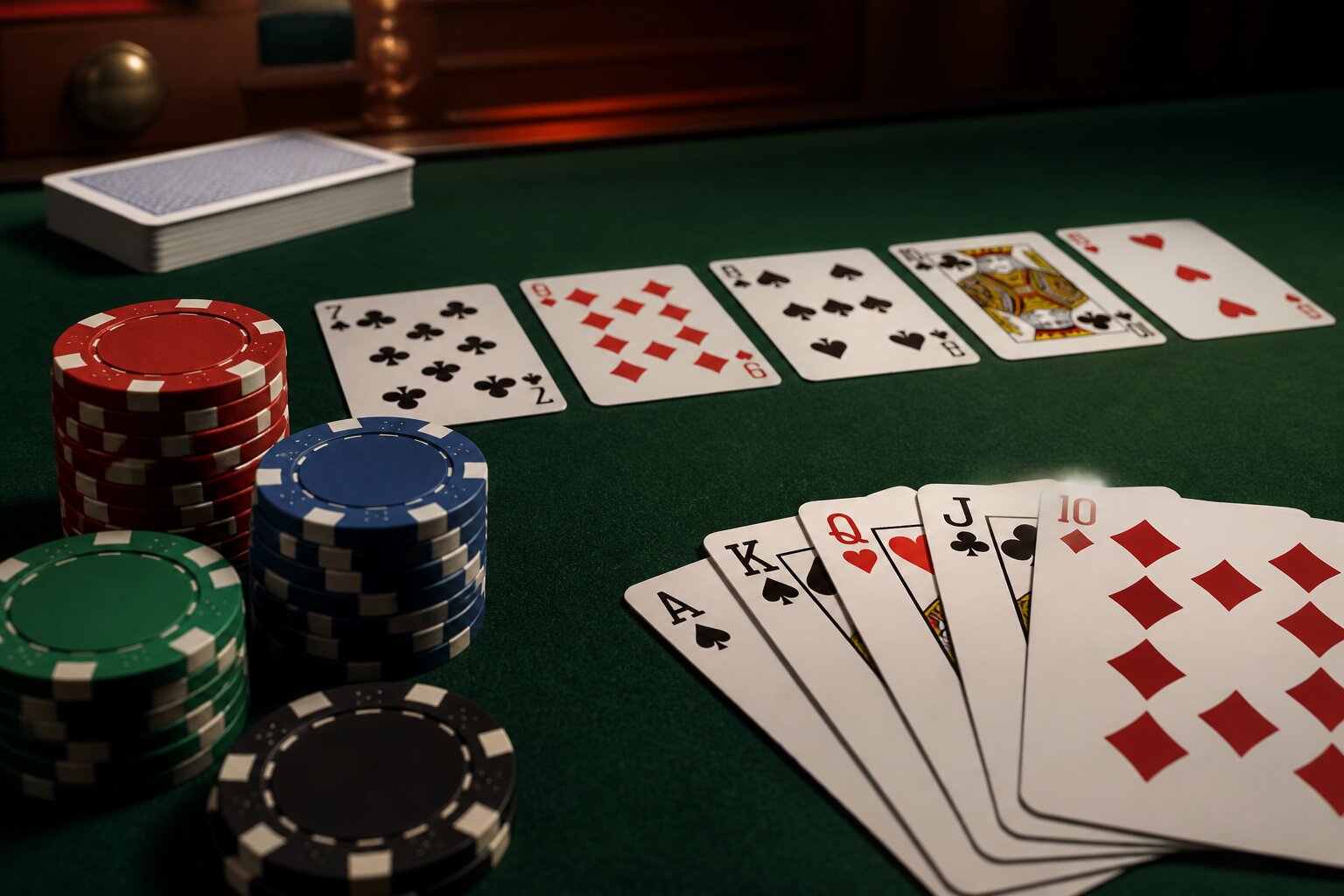
- Royal Flush: Ace, King, Queen, Jack and Ten all in the same suit. This is the top-ranked hand.
- Straight Flush: Five consecutive cards of the same suit.
- Four of a Kind: Four cards of the same rank, plus one side card.
- Full House: Three cards of one rank and two of another.
- Flush: Five cards of the same suit that are not in sequence.
- Straight: Five cards in sequence, suits can vary.
- Three of a Kind: Three cards of the same rank plus two unrelated side cards.
- Two Pair: Two different pairs plus one side card.
- One Pair: Two cards of the same rank plus three side cards.
- High Card: When no other hand is formed, the highest card determines the winner.
Recognising these hands quickly will change how you read situations at the table. A solid grasp of rankings lets you judge whether to continue in a hand or conserve chips for better opportunities.
Must-Know Poker Terms & Phrases
Poker has its own shorthand that makes conversation at the table faster. Knowing these terms helps you follow action and communicate clearly without slowing the game down.
Betting refers to putting chips into the pot during your turn. To call is to match the current bet; to raise is to increase it; to fold is to surrender your cards and any claim on the current pot. Checking means passing your turn without betting when no bet has been made.
Community-card games like Texas Hold’em use the terms flop, turn and river for the first three, fourth and fifth community cards respectively. The pot is the total sum players can win in a hand. A blind is a forced bet posted before cards are dealt to create action; going all-in means staking all your remaining chips.
Familiarity with this vocabulary reduces hesitation and keeps play smooth. If you’re unsure of a term during a game, asking for clarification is perfectly acceptable.
Which Starting Hands Should You Play?
Choosing starting hands is about balancing potential with risk. Some hands are generally stronger and give a clearer path through the later betting rounds, while others require more careful play or better table position.
Premium holdings such as high pairs (Aces, Kings, Queens) and strong broadway combinations like Ace-King or Ace-Queen often justify more aggressive play because they have multiple ways to win. Middle pairs and suited connectors can be valuable too, particularly if the table is passive and you can see community cards cheaply. Low, unconnected cards tend to perform poorly over time and are usually folded unless there is a specific tactical reason to play them.
Position at the table also matters: acting later gives you more information about opponents’ actions and can turn marginal hands into playable ones. Over time, combining careful hand selection with attention to position and opponents’ tendencies becomes the heart of solid opening strategy.
How Do Betting Rounds Work in Poker?
Betting rounds structure the flow of information and decision-making in poker. Each stage provides new cards or options and a fresh chance to assess your position relative to other players.
The game progresses through distinct stages, each with its own dynamics and strategic considerations:
- Pre-flop: players act based on their private hole cards before any community cards are shown.
- Flop: three community cards are revealed, which can alter the relative strength of many hands.
- Turn: a fourth community card is added, often narrowing draws and clarifying intentions.
- River: the fifth and final community card is dealt, followed by the last opportunity to bet before showdown.
Understanding how these stages interact helps you interpret betting patterns and judge whether continuing is a sensible choice given your own limits and risk tolerance.
Pre-Flop
This initial stage determines who stays in once the community cards arrive. The choices players make here often reflect hand strength and table position. Early position usually requires tighter, more selective play, while later position permits a wider range of actions because you can see more of your opponents first.
Decisions at this point also set expectations for later betting rounds. A large raise can indicate strength, but it can also be used to steal blinds or gain positional advantage. Conversely, calling or limping can mask the true value of a hand, making later decisions more complex.
Flop
The first trio of community cards usually produces the most dramatic changes in hand strength and betting lines. Hands that looked strong pre-flop can suddenly be behind, while speculative hands may complete key draws.
After the flop, evaluate how the new cards interact with both your hole cards and the likely ranges of your opponents. Consider the size of bets relative to the pot, since that affects the price of chasing draws and the level of commitment required to continue.
Turn
With the fourth card revealed, draws narrow and decisions become more committed. Many players view the turn as a point where size and intent become clearer, because large bets here often demand significant calls on later streets.
This is a stage to recheck pot odds and fold equity. If you have a drawing hand, the cost of continuing versus the potential payoff needs careful consideration. For made hands, think about whether you want to extract value now or conceal strength to get more on the river.
River
The final community card completes possible hands and leads to the last round of betting before a showdown. At this stage, there are fewer unknowns, so players must decide whether their hand can beat realistic calling ranges or whether it is better to check and avoid further loss.
River play often revolves around whether to value bet thinly, to bluff, or to make a safety check. Reading prior betting patterns from earlier streets can provide vital clues about opponents’ likely holdings and intentions.
Getting comfortable with how each stage alters the range of likely hands makes it easier to read opponents and manage your own exposure in a controlled, measured way.
Common Poker Actions: Call, Raise, Fold
Across betting rounds, the three most frequent actions are calling, raising and folding, and each carries a different purpose. Calling is a way to stay in the hand without increasing stakes, useful when you believe your chance of winning is reasonable but don’t want to escalate the pot. Raising pressures opponents and can be used both to build value with strong holdings and to force marginal hands out. Folding conserves resources when the odds of success are low.
The best choice depends on your cards, table dynamics and how comfortable you are with the possible outcomes at that moment. Thoughtful choices over time are what separate steady players from those who give away chips unnecessarily.
Essential Poker Table Etiquette in the UK
Good etiquette keeps games fair and enjoyable for everyone. Clear, timely actions help the game move, so be ready when it’s your turn and avoid deliberate slow play. Refrain from discussing your cards or advising others while a round is live, as that can unintentionally influence decisions.
Be courteous to the dealer and fellow players. Avoid aggressive language or excessive celebration; polite behaviour preserves a welcoming atmosphere and reduces the chance of disputes. If a disagreement arises, follow the house rules or the moderator’s guidance to resolve it calmly.
Keeping play civil and predictable makes the experience better for the whole table.
Are There Myths About Cheating in Poker?
Popular culture sometimes makes cheating look easy or widespread, but regulated venues and reputable platforms employ robust systems to keep the game honest. Surveillance, account monitoring, and audited software are all part of how operators protect fair play.
Cheating carries severe consequences, including bans and legal penalties. Rather than worrying about unlikely scenarios, focus on playing within the rules and reporting any irregularities to the operator so they can investigate. Playing at venues and sites that publish their fairness and security policies adds an extra layer of reassurance.
If you ever have concerns about fairness, the operator’s support team is the first point of contact for clarification or dispute resolution.
Quick Reference Tables for Poker Hands
A compact reminder of hand rankings is useful while you’re learning. Below is a concise table that summarises the main hands from strongest to weakest, so you can check at a glance while you build familiarity.
| Hand Name | Description |
|---|---|
| Royal Flush | A, K, Q, J, 10 of the same suit |
| Straight Flush | Five cards in sequence, same suit |
| Four of a Kind | Four cards of the same rank |
| Full House | Three of one rank and two of another |
| Flush | Five cards of the same suit, any order |
| Straight | Five consecutive cards, any suits |
| Three of a Kind | Three cards of the same rank |
| Two Pair | Two separate pairs |
| One Pair | Two cards of the same rank |
| High Card | Highest individual card when no other hand applies |
Keep this table handy while you practise; with time you will recognise these patterns without needing a reference.
Frequently Asked Questions About Playing Poker
New players often have similar questions, and the answers below aim to clear up the essentials while pointing to where to find further help.
Is poker a game of skill or chance?
Poker combines skillful decision-making with the randomness inherent in card distribution. Developing strategy, reading opponents and managing your bank are all skills that improve results over time.
How old do you need to be to play poker for real money in the UK?
You must be at least 18 years old to play for real money in the UK. Always verify age checks and follow the venue’s rules.
Can I set limits when I play poker online?
Yes, reputable platforms provide tools to set deposit, loss and session limits, and options for time-outs or self-exclusion. Using these features is a practical way to keep control over your play.
What should I do if poker stops being fun?
If it stops being enjoyable, stepping away is a reasonable choice. Many sites and venues offer measures to help, and confidential support organisations can provide guidance if you feel you need it.
Are online poker games fair?
Operators publish information about how their games are tested and audited. Look for clear statements on fairness and for channels to raise any concerns.
If you have more specific questions, the operator’s help pages and recognised support organisations provide reliable guidance. Play with clear limits, stay aware of how you feel while playing, and enjoy improving your game; that approach will keep your sessions constructive and satisfying.
**The information provided in this blog is intended for educational purposes and should not be construed as betting advice or a guarantee of success. Always gamble responsibly.