
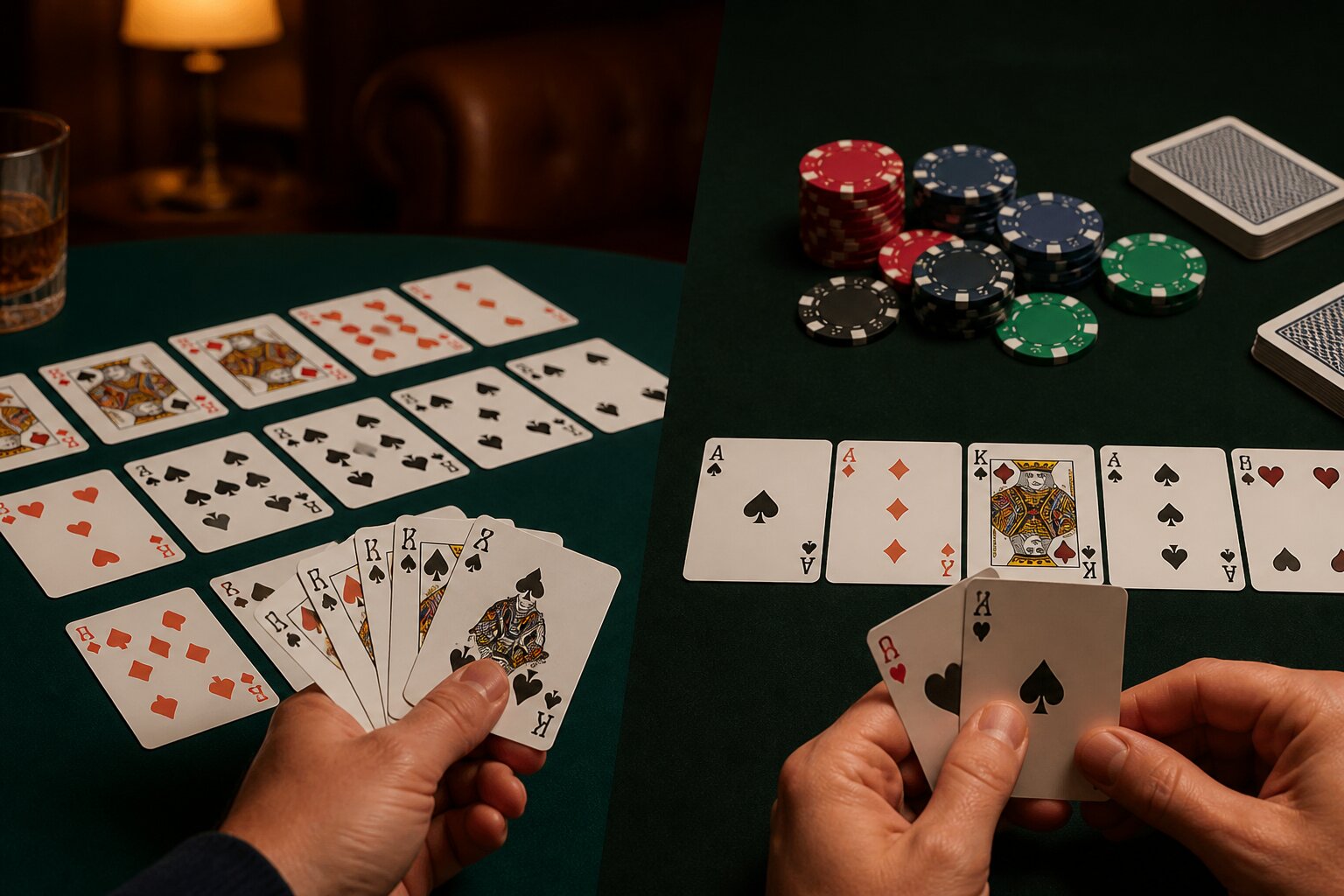
If you enjoy card games, you’ve probably wondered what really separates Rummy from Poker. Both are widely played across the UK and online, but they reward different skills and appeal to different kinds of players.
This post breaks down how each game works, the rules you’ll encounter, and the strategies that matter most. Read on to find which one suits your next game night.
Curious which game matches your style? The comparisons that follow will make the choice clearer.
What Are the Main Differences Between Rummy and Poker?
Rummy and Poker both use standard playing cards, but they set distinct goals and create very different table dynamics. Each game places emphasis on different skills and habits, which leads to varied pacing and social interaction at the table.
Objectives
In Rummy, the aim is to form sets or runs: groups of the same rank or sequences in one suit. A valid declaration, which commonly requires at least one pure run, ends the round and decides the winner. Rummy scores are typically based on the points held in opponents’ hands when a declaration is made, so minimising those points is important.
Poker’s objective is to make the best five-card hand according to a fixed hierarchy, or to win the pot by convincing other players to fold through betting. The focus is on relative hand strength and table position. Success can come from having a superior hand, from successful bluffing, or from applying pressure through betting to extract value or induce folds.
Gameplay
Rummy proceeds through a steady cycle of drawing and discarding. Players build their hand progressively, arranging cards into melds while observing opponents’ discards to infer what they need. The pace tends to be measured, with incremental improvements to the hand and regular opportunities to adapt strategy as the round unfolds.
Poker is structured around betting rounds. Decisions to bet, call, raise, or fold shape the round and can be used strategically to influence opponents’ choices. Some variants introduce shared community cards that everyone can use, which alters hand-building and the information available to all players. The flow of a poker hand can shift quickly, with large swings in stakes based on players’ decisions.
Strategy
Rummy rewards careful observation, memory, and long-term planning about which cards to keep or release. Timing a declaration and limiting points held by opponents are central skills. Players also balance risk and reward when choosing which discards are safe and which might help an opponent.
Poker combines card knowledge with betting strategy, position, and the ability to interpret opponents’ behaviour. Tactical aggression and defensive play both have their place, depending on the situation. Reading betting patterns, adjusting to different opponents, and managing stakes are all important elements of effective poker play.
These contrasts show how gameplay and decision-making differ, even when the same deck is used. Both games offer strategic depth but reward different combinations of observation, patience, and psychological skill.
Understanding the Basic Rules of Rummy
Rummy typically plays with two to six participants and one or two standard decks. Players receive a fixed hand size—13 cards in the common version—and then work to form valid sets and runs. A set means three or four cards of the same rank; a run is three or more consecutive cards in the same suit.
Rounds move through draws and discards, and a legitimate declaration requires at least one pure run, meaning a sequence formed without jokers. When a player declares, hands are revealed and any unmatched cards are scored—those remaining in other players’ hands contribute to their penalty total.
Success in Rummy depends on reading the flow of cards and balancing the urge to complete your own combinations with the risk of helping someone else. Card distribution randomness affects outcomes, but skillful choices over many rounds determine consistent results.
Understanding the Basic Rules of Poker
Poker covers many variants, with Texas Hold’em and Omaha among the most common. Players receive private cards, and in some versions a set of community cards is dealt for everyone to use. The round unfolds through betting phases where chips move into the pot based on players’ choices.
Hands are compared against a fixed ranking system that ranges from high card up to the top combinations such as a Royal Flush. The round ends with a showdown if multiple players remain; otherwise the last player standing wins the pot. Games may be played with limits on bets or with no-limit stakes.
Poker places emphasis on hand selection, bet sizing, table position, and opponent tendencies. Random card distribution plays a part in each deal, yet strategic betting and reading the table are what separate strong players from the rest.
Which Card Decks and Player Counts Are Used?
Both games generally use a standard 52-card deck, with jokers appearing in some Rummy variants as wildcards. Rummy commonly uses one deck for two to four players, and two decks plus jokers when more players join or when the variant calls for extra cards. Some Rummy versions also use stripped decks that remove low cards to change the game dynamics.
Poker most often uses a single 52-card deck without jokers, though certain home-game rules or novelty formats may add them. Poker is flexible in terms of player count: it ranges from heads-up play between two players to full ring games of up to ten players at a single table. Tournament formats can scale much larger by running multiple tables and moving players as rounds progress.
Different variants may change the number of cards dealt, the presence of jokers or wildcards, or the composition of the deck, so it helps to check the specific rules before play begins. Both games adapt well to casual home play, organised club nights and formal events, provided organisers agree the variant and deck configuration in advance.
How Are Hands Ranked in Rummy vs Poker?
Rummy does not rank hands by strength the way Poker does. Instead, hands are evaluated on whether they meet the required structure of sets and runs. A pure run is especially important because it validates a declaration. When scoring, only the unmatched cards in the other players’ hands count against them.
Poker uses a strict hierarchy of hands that determines the winner at showdown. From high card up to combinations like straight, flush, full house, and more, each hand type beats all those below it. Learning that hierarchy is essential for making informed betting decisions.
Understanding this difference clarifies why the two games feel so distinct at the table: Rummy is about forming legal combinations, while Poker is about producing or representing the best-ranked hand.
How Does Gameplay Flow Differ?
Rummy’s flow is rhythmic and incremental: draw, evaluate, discard. Players steadily refine their hands while watching discards to gauge opponents’ needs. A round concludes when someone believes their cards satisfy the declaration rules and asks to show.
Poker flows in segments marked by betting rounds. The stakes can rise quickly, and decisions are as much about managing the pot and opponents as about the cards in hand. Community-card formats create shared information that changes how players assess their chances as the hand progresses.
These structural differences create contrasting table atmospheres. Rummy often encourages focused, incremental planning; Poker prompts situational reads and dynamic responses to other players’ bets.
What Are the Key Ways to Win in Each Game?
In Rummy, winning occurs when a player has organised their hand into valid sets and runs and declares before others. Minimising ungrouped cards is important, since those count as penalties if another player finishes first. Players watch the discard pile and opponents’ actions to avoid helping them complete combinations.
In Poker, a player wins either by holding the highest-ranked five-card hand at showdown or by making opponents fold through betting. Victory can come from a strong hand shown at the end or from well-timed pressure that removes competition. Both games reward observation of opponents, but they apply that information in different ways.
Whether you aim to complete combinations or to control the pot, both games demand attention to the evolving table state and to how other players are behaving.
Is Rummy Easier to Learn Than Poker?
Many beginners find Rummy quicker to pick up because its objectives are concrete: form sets and runs. There is less emphasis on betting tactics and on memorising a long hierarchy of hands. That said, mastering timing and discard choices in Rummy still takes practice.
Poker introduces more layers at the start: hand rankings, betting options, and the strategic implications of position and pot odds. Players who enjoy psychological interplay and risk management may find Poker rewarding, even if the initial learning curve is steeper.
Personal preference and prior experience with card games will influence which one feels easier. Trying both in low-stakes or social settings is the best way to discover which aligns with your instincts.
Common Myths About Rummy and Poker Explained
Some widespread beliefs about these games can mislead newcomers. One is that success is purely a matter of fortune. While random card distribution affects any single hand, skillful decision-making over many hands is what produces consistent positive results. Another myth is that experienced players never lose. Even strong players encounter losing periods; variance is part of card play.
It is also untrue that high stakes are required to enjoy either game. Plenty of low-limit or free games provide a safe environment to learn. And neither game should be treated as a source of income. Treating play as entertainment and setting clear limits helps keep it enjoyable.
If you feel play is affecting you negatively, seek support and consider stepping back. Playing within set boundaries keeps the experience healthy for everyone involved.
Which Game Is More Popular in the UK?
Both Rummy and Poker have solid followings in the UK, but they tend to occupy different spaces. Poker enjoys prominence in competitive circles, televised events, and organised cash games, which raises its public profile. Rummy is often chosen for social gatherings and family games, prized for its straightforward format and easy turn-taking.
Each game attracts players for different reasons: Poker for competitive play and strategic depth; Rummy for steady, card-focused gameplay. Choose the one that matches the mood you want for your next game night.
Whether you prefer steady strategy or the tactical pressure of betting, both games offer rewarding play when approached with clear limits and a focus on enjoyment.
**The information provided in this blog is intended for educational purposes and should not be construed as betting advice or a guarantee of success. Always gamble responsibly.