
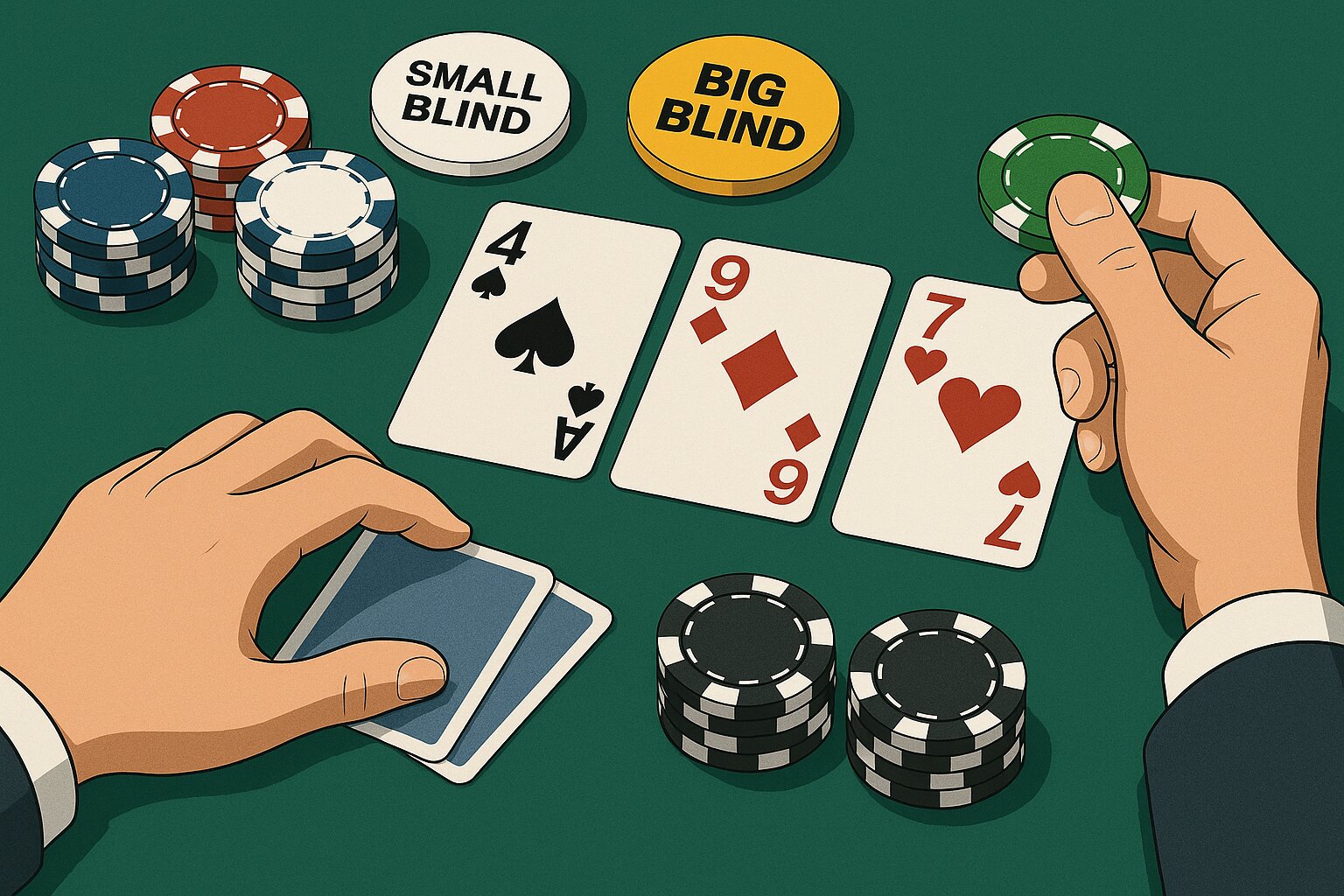
If you’ve ever sat down at a poker table, you’ll notice the small and big blinds come around like clockwork. For many players, knowing what to do when the big blind reaches your seat can be confusing at first.
This article explains what the big blind is, why it exists, and when you must match it to keep playing. Read on for clear, practical rules that will help you feel more confident at the table.
What Is the Big Blind in Poker?
The big blind is a forced bet placed before any cards are dealt. It and the small blind are used in community-card games such as Texas Hold’em and Omaha to ensure there is money in the pot from the outset.
The player two seats to the left of the dealer posts the big blind. The amount is determined by the table stakes and stays the same for that game unless the stakes change. After each hand, the dealer button and the blind positions move one seat to the left so every player will take turns posting them.
The purpose of the big blind is to create initial action and prevent every player from waiting indefinitely for premium hands. By seeding the pot, blinds encourage betting, decisions and meaningful play right away.
When Do You Need to Match the Big Blind?
If you want to remain in a hand after the cards are dealt, you must at least match the big blind, an action called calling. Play proceeds clockwise from the player to the left of the big blind, and each player on their turn chooses to fold, call, or raise.
If no one raises before your turn, matching the big blind is the minimum required to see the next round of cards. If there has been a raise, you must match the raised amount to continue. Choosing to fold at this stage simply removes you from the current hand and you wait for the next deal.
This rule is consistent across live and online tables for games that use blinds and helps keep play fair and predictable for everyone involved.
Exceptions: Forced Bets & Special Cases
There are a few variations to how forced bets can appear, depending on the game format.
The small blind is a separate forced bet posted by the player immediately left of the dealer, typically smaller than the big blind. Some games also use an ante, a small contribution that every player posts before the hand begins; when an ante is in play, everyone must contribute it in addition to any blind they might be required to post.
Special cases such as missed blinds occur when a player joins late or leaves and returns. In these situations the house rules may require the returning player to post a blind or an amount to “catch up,” ensuring they have contributed appropriately relative to those who have been seated and playing.
These variations exist to balance fairness with the practical flow of the game, so it’s sensible to be familiar with the specific table rules before you sit down.
What Happens If You Don’t Match the Big Blind?
Declining to match the big blind results in folding immediately. Your cards are collected and you cannot win that hand’s pot. Folding at the pre-flop stage is a common choice when the hole cards do not justify the stake or when facing a raise you do not wish to meet.
Once you fold, you simply await the next deal. The blinds will have moved around the table by then, so your relative position and required contribution may change in the following hand.
There are some practical consequences to be aware of when you do not match the big blind:
- You forfeit any claim on the current pot and lose whatever chips you have already contributed to that hand.
- You are removed from the action for the remainder of that hand and will not see the community cards.
- Your folded hole cards are collected and will not be shown unless rules or house procedures require a showdown.
This mechanic prevents players from remaining in hands without having matched the agreed stakes, and helps keep the action moving in a fair and predictable way.
Understanding Posting Out of Turn
Order of action matters in poker because it preserves fairness and stops players from gaining information they should not yet have. Posting or betting out of turn means placing chips into the pot before it is officially your turn, and it can disrupt other players’ decision-making.
Such mistakes are handled by dealers and game staff under established rules. The aim is to correct the action and preserve the proper sequence so that no player is advantaged or disadvantaged by the error.
If the disruption is minor, the posted chips may remain in the pot and your action will become binding when your turn arrives. Repeated or deliberate breaches can incur warnings or penalties according to the house rules, so maintaining awareness of turn order is important.
Penalties and Corrections
When a player posts out of turn, staff will usually intervene and apply a corrective procedure. Often, the chips are left in the pot and treated as a bet that becomes official once it is the player’s turn. If a posting affects the options available to others, additional adjustments may be made to restore fairness.
In some venues, persistent errors result in formal warnings or a requirement to sit out hands. The exact response varies by venue, but the consistent principle is to protect the fairness and rhythm of play.
Do Big Blind Rules Differ Between Poker Variants?
The blind structure is not universal across all poker games. Community-card games like Texas Hold’em and Omaha use small and big blinds, but other variants handle forced bets differently.
For instance, Seven Card Stud typically uses an ante system where all players post a small amount each hand rather than taking turns posting larger blinds. Tournament formats may also include changes to blind levels as play progresses, increasing the stakes at set intervals.
House or tournament rules sometimes introduce additional tweaks, such as dead blinds or straddles, which alter the usual sequence for strategic or pacing reasons. If you’re unsure about the specifics for a particular game or event, asking the dealer or checking the posted rules will clarify what to expect.
Now that you know how blinds function across different formats, it’s easier to adjust your approach when moving between cash games and tournaments.
Common Misconceptions About the Big Blind
Several myths circulate about the big blind, and clearing these up helps new players make better decisions.
One false belief is that paying the big blind is optional. In games that use blinds, matching the big blind is required to remain in the hand. Another is that every poker game uses blinds; in truth, only certain variants do, while others rely on antes or different forced-bet systems.
Some players assume the blind amount changes at random, but in practice the size is set by the table stakes and altered only at predefined points in tournaments or when players agree to change cash-game stakes. Understanding these facts removes a lot of uncertainty and helps you focus on reading the table and the betting pattern rather than worrying about procedural questions.
Summary: Key Points on Big Blind Matching
To recap the essentials: matching the big blind is the minimum action needed to stay in a hand in games that use blinds, and the blinds rotate so everyone shares that responsibility. Not every poker variant uses blinds, so learn the rules of the game you’re playing. Posting out of turn can lead to corrections or penalties because order of action preserves fairness.
Follow the house rules, stay aware of your turn, and you’ll find the mechanics of blinds are straightforward once you experience them a few times. If you have questions at a table, asking the dealer for clarification keeps play smooth and ensures everyone understands the same rules.
**The information provided in this blog is intended for educational purposes and should not be construed as betting advice or a guarantee of success. Always gamble responsibly.