
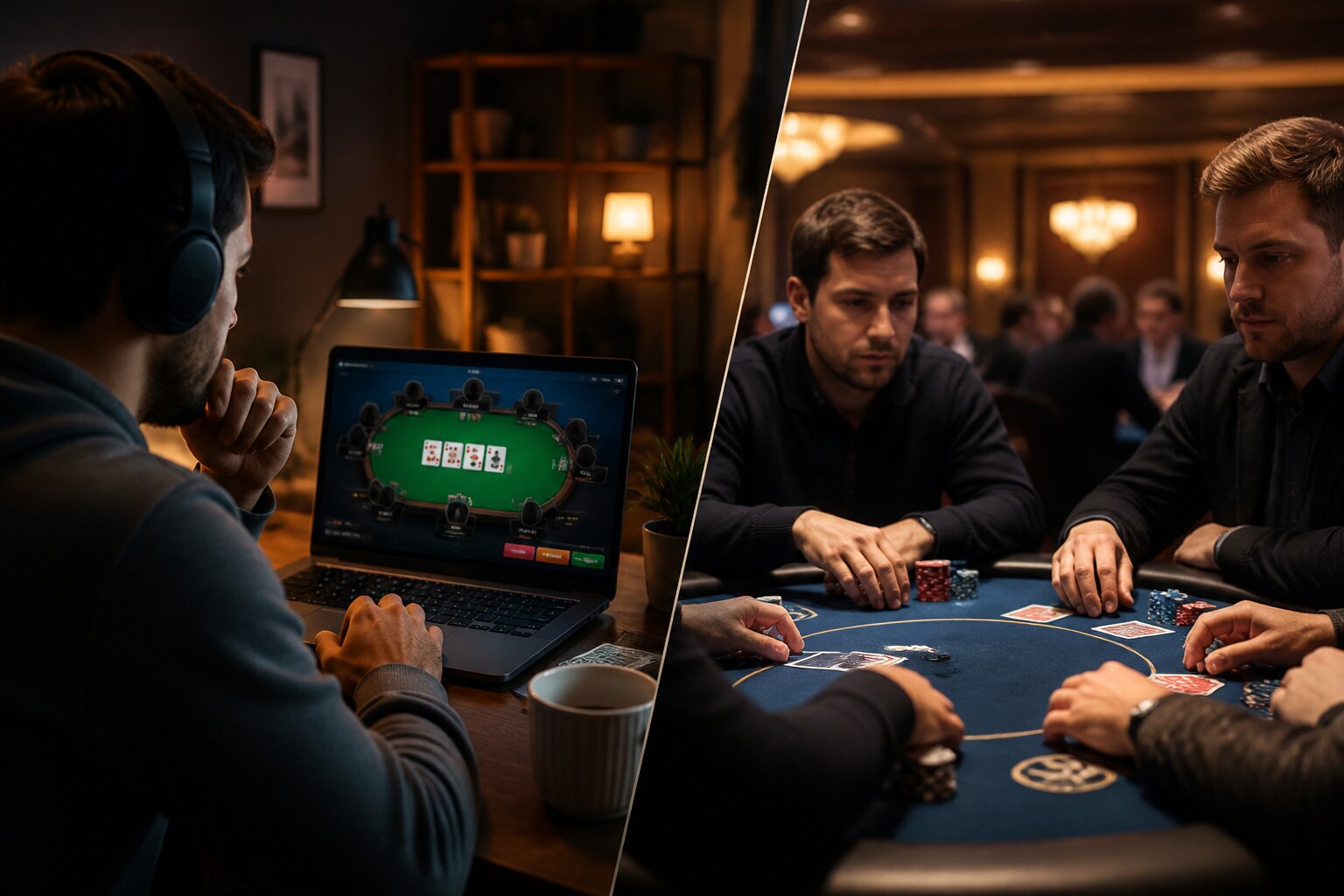
Have you ever wondered if playing poker online is tougher than sitting at a real table? You’re not alone—many players weigh up the two formats before committing time or money.
Whether you favour the speed of screens or the feel of a felt table, understanding how each setting changes the game will help you play smarter and enjoy it more. In the sections that follow we compare the key differences, explain the particular challenges of each, and offer practical context so you can decide which suits you best.
Key Differences Between Online And Live Poker
Online and live poker use the same rules, but the way hands are played and decisions are made can be very different. These differences affect pace, the information available to players, and the kinds of strategies that work best. They also influence session planning, bankroll management and the psychological approach you bring to the table.
Game Speed
Online poker generally moves much faster. Hands are dealt immediately and players make decisions in a matter of seconds. This rapid pace means you will see many more hands per hour online than live, which can increase short-term variance and requires tighter time and emotional control.
Live poker is slower. Shuffling, dealing, and the physical handling of chips extend the time between hands. The slower rhythm gives more time to think, observe opponents and recover between big pots, but it also reduces the total number of bets you can make in a session.
Faster play online increases the number of hands you will see in a session, which changes how you manage focus and bankroll. It also makes table selection and session length important parts of your strategy.
Player Behaviour
At a live table you can observe posture, facial expressions and small habits that may help interpret opponents’ behaviour. These physical tells can be subtle but useful when combined with timing and betting patterns.
Online play removes those visual cues. Instead, patterns in betting size, timing and frequency become the primary sources of information. Many online players also use software tools and heads-up displays to track tendencies over time, so learning to read these patterns is a core skill for online players.
Both formats demand psychology and discipline, but the cues and countermeasures you use will differ substantially between live and online play.
Available Stakes and Game Choices
Online sites typically offer a wider selection of stakes and formats around the clock. Live venues tend to have fewer tables and fixed schedules, so the variety you find depends on the venue and the time you visit.
Typical differences include:
- A broader range of stakes online, from micro to high stakes.
- More game formats online, such as turbo, sit and go, and mixed games.
- Greater scheduling flexibility online, with games running 24/7.
These differences affect how easy it is to move up or down in stakes, find action that suits your style, and practise specific variants.
Table Size
In a live setting you usually concentrate on a single table, which allows you to focus closely on one group of opponents and their tendencies. Seats are fixed, so positional play and live dynamics become more prominent.
Online, some players multi-table, playing several games simultaneously. Multi-tabling increases volume and potential profit but demands stronger concentration, good organisation and quicker decision-making. It also makes bankroll and time management more important, since you are exposed to more variance in the same period.
Environment
The setting matters. Online play happens in private spaces where distractions differ from those in a casino or poker room. Home distractions might include family, phone notifications and other open tabs, while playing in a cafe or other public place adds different interruptions.
Live venues include noise, other players, staff and promotions. These factors can affect your emotional state, table talk and comfort level.
Common environmental differences include:
- Background noise and music in a casino.
- Physical proximity and table talk from other players.
- Digital distractions and multitasking when playing at home.
Each environment changes how you pace yourself, interact with others and maintain concentration.
Before playing in either format, check that you meet legal age and jurisdictional requirements and set personal limits you can stick to. Play responsibly and seek help if gambling is causing harm.
Why Do Some Players Find Online Poker More Challenging?
Many players report that online poker feels harder at first. The reasons are practical rather than mysterious, and understanding them helps you adjust.
Speed and Volume of Play
Online sessions typically deliver far more hands per hour than live games. That means decisions come quicker and there is less time to reflect between rounds.
For newer players this tempo can be overwhelming. Small errors can stack up fast, and it takes practice to keep decision quality high over long, concentrated sessions.
Limited Player Information
Without physical tells, online players must rely on other sources of information. This shifts emphasis towards patterns and long-term observation rather than trying to read a single action.
Common sources of online information include:
- Betting patterns and bet sizing.
- Timing information, such as how quickly opponents act.
- Hand history notes and statistics gathered over many hands.
Developing the ability to interpret those cues accurately takes time and a statistical mindset.
Player Pool Diversity
Online tables often mix players from many regions and playing backgrounds. That produces a wide range of styles, from very tight and passive to extremely loose and aggressive.
The variety makes opponents harder to classify quickly, and a strategy that works well against one group may be less effective against another. Adapting to changing table dynamics becomes an important skill.
Technical Skills
Using poker software effectively is part of online play. Learning to track hand histories, read HUDs, and manage multiple tables are skills in themselves.
Useful technical abilities include:
- Installing and configuring tracking tools.
- Analysing hand histories to spot leaks.
- Juggling several tables while maintaining concentration.
Newcomers need to allow time to gain confidence with these tools before expecting peak performance.
Focus and Distractions
Playing from home or on a mobile device introduces different distractions than a casino environment. Background noise, messages, and interruptions can all break concentration.
Establishing a consistent routine and minimising interruptions helps maintain focus. Simple measures such as a quiet space, scheduled breaks, and blocking notifications often make a noticeable difference.
These elements combine to create the tougher initial learning curve online, but they also provide faster feedback for players who work on their game and habits.
Understanding The Online Poker Environment
The online environment is shaped by software, anonymity and rapid play. Knowing how these elements interact helps you form realistic expectations and adapt your approach.
Online play changes the rhythm and the information available to you. Software enforces rules and timing, anonymity limits reads to actions rather than faces, and faster dealing means you see more hands in the same span of time. Together, these factors alter which skills are most valuable and how you manage both risk and decision quality.
Increased Speed Of Play
Hands follow one another quickly online, so patterns emerge faster and you receive more information per hour. That can accelerate learning because you encounter a wider variety of situations in less time.
Faster play also increases variance in short sessions. A good or bad run can happen quickly, and results over a few hours may not reflect true skill. Players who are used to live pacing may need to slow their decision process deliberately to keep errors down and avoid tilting after rapid swings.
Managing the speed of play means balancing volume with attention. Take breaks, use session goals, and resist the temptation to rush decisions purely because the software allows it.
Use Of Technology And Tools
Platforms often include useful features, such as:
- reviewing hands to study past decisions,
- taking notes on opponents to record tendencies,
- customising table display and HUD elements for clearer information.
These tools help players record tendencies and study performance more systematically. They can highlight leaks in your game and show trends in opponents' behaviour.
While useful, they are aids rather than shortcuts. Good use of tools requires judgement: knowing which stats are meaningful, avoiding over-reliance on small samples, and integrating what the tools show with sound poker reasoning.
Player Anonymity Online
Most online players use screen names, which means you rarely know much about opponents beyond their actions at the table. That anonymity reduces some forms of psychological play and places greater emphasis on consistent strategy and pattern recognition.
Because you cannot rely on physical tells, focus on observable factors: bet sizing, timing patterns, positional tendencies and showdown hands. Over time, these elements form a profile you can exploit.
Knowing how these factors change the feel of the game will help you focus on the right skills for online play. Adapting to the environment — through disciplined decision making, sensible use of tools and careful observation — is key to steady improvement.
How Does Live Poker Compare?
Live poker has its own mix of practical and social elements that shape decisions and enjoyment. The pace of play can be slower than online, the physical handling of chips and cards adds a tactile element, and face-to-face interaction with other players changes how information is exchanged. Together these factors influence how each hand and the broader session unfold.
The differences mean live and online play often suit different skills and temperaments. Many players find the two formats complement each other: live games build social awareness and tablecraft, while online play offers volume and practice on technical decision making.
Tells And Table Dynamics
Being able to observe opponents directly lets you collect information in ways that do not exist online. Small gestures, speech patterns, and how a player handles chips all contribute to a richer picture.
- Small facial expressions and eye movements
- Changes in tone, pace or the words a player uses
- Handling of chips, cards or cards tucked away after a hand
Interpreting these signs requires patience and context, since behaviours vary widely between players. A single gesture rarely tells the whole story. Good table dynamics reading comes from watching patterns over many hands, noting how a player behaves in different situations, and cross-checking that behaviour against the cards and betting patterns you see.
Other live-specific dynamics also matter, such as seating position, stack sizes at the table, and the dealer’s speed. These practical factors influence strategy in ways that are less prominent online and can alter how quickly pots build or how aggressive players become.
Social Factors And Atmosphere
Playing in person brings social interaction to the foreground. Conversations, shared reactions and the general rhythm of a table can affect focus and mood.
- Chat and banter that can slow the game or shift attention
- Collective reactions to big pots that influence table tempo
- A table’s rhythm, which can be steady and professional or loose and talkative
For some players this social element adds valuable learning opportunities and makes sessions more enjoyable. For others it can be a distraction or create pressure. If you are starting out at live tables, spending time watching the flow of play before joining can help you acclimatise and make more measured decisions. Observing how a table treats mistakes, how dealers manage action, and how quickly players adjust their play will give you a clearer sense of whether to join and how to approach the session.
These differences make live and online play complementary learning environments rather than direct substitutes. Each offers learning opportunities the other does not, so many players use both to develop a rounded game.
Common Misconceptions About Online Vs Live Poker
A few persistent myths colour how people approach poker. Clearing them up helps set sensible expectations and makes it easier to decide which format suits your aims and temperament.
Fairness Of Online Games
There is a common belief that online poker outcomes are manipulated. While unscrupulous sites do exist, reputable operators use certified random number generators and audited systems to ensure hands are dealt fairly. Many regulated platforms publish audit results or certification details, offering transparency about how their games are run.
Choosing a site licensed by a recognised regulator reduces the risk of unfair practices. Look for clear terms and conditions, independent audits, and visible licensing information before playing.
Skill Level Required
Both formats attract a wide range of players. Neither online nor live play is inherently easier or harder in absolute terms; each rewards different skills.
Online play tends to favour:
- pattern recognition and the ability to process many hands quickly
- volume and study tools such as hand trackers and databases
- mental endurance for long sessions at a fast pace
Live play values:
- observational skills, such as reading opponents and picking up physical tells
- table dynamics and the social aspects of interaction
- patience and managing changing game flow over a longer timescale
Recognising these differences helps you target your practice and study to the format you prefer.
Guaranteed Outcomes
No format guarantees consistent winnings. Short-term variance can affect any session, so successful players concentrate on long-term decision quality, sound responsible play, and continuous learning rather than expecting fixed results.
Responsible play means setting limits, treating losses as part of the game, and keeping expectations realistic. If you feel gambling is becoming a problem, seek help from appropriate support services. Clearing these misunderstandings helps you approach each format with a clearer plan and realistic goals.
How Do Game Formats Impact Difficulty?
The format you choose — cash games, tournaments, or other variants — changes the mental approach and the kinds of challenges you face during play. Each format steers your focus towards different skills, time commitments and decision rhythms, so recognising those differences helps you choose the best learning path.
Cash Games
Cash games treat chips as direct monetary value and allow players to enter or leave freely. They produce a steady environment where focus centres on each hand’s immediate profit potential.
Common recurring themes in cash games include:
- Position and how it affects the range of hands you can play.
- Bet sizing decisions to extract value or control the pot.
- Pot control strategies to limit variance and manage risk.
Because stacks and blinds remain stable, cash games reward consistent, repeatable decisions and sound bankroll management. Sessions can be long or short, so matching the format to the time you have available is important.
Tournaments
Tournaments start with equal chip stacks for all players and escalate pressure as blinds rise. The changing blind structure and finite chips create situations where short-term EV is not the only consideration; survival and chip accumulation both matter.
Play in tournaments often requires:
- Shifting between tight and aggressive strategies as stack depths change.
- Making push-or-fold calculations when blinds and antes make calling less attractive.
- Considering payout structures and bubble dynamics when choosing risk levels.
Patience and forward planning are rewarded, since adaptable play over many levels typically beats optimising individual hands in isolation.
Sit & Go’s and Other Variations
Formats such as Sit & Gos and knockout events compress the experience into quicker sessions with specific incentives and prize structures. These games often intensify early-table dynamics and accelerate the move to late-stage, high-pressure spots.
They require fast adjustments to:
- Shorter time horizons and rapidly changing stack sizes.
- Altered incentives such as bounties or winner-takes-all payouts.
- Opponents who may switch gears more abruptly than in longer formats.
Choosing a format that matches your temperament and available time will make learning more productive. Consider how much variance you can tolerate, the skills you want to develop, and how much time you can commit when deciding where to focus your practice.
Which Is Best For Beginners?
Beginners can succeed in either format by matching their early choices to what they want to learn and how they feel most comfortable. Your personal goals and temperament should guide whether you start online, live, or a mix of both.
Online poker lets new players practise many hands in a short time, try different formats and review recorded play. It offers convenience and repeatability, which support rapid skill-building. Typical benefits include:
- practising a large volume of hands at low stakes
- experimenting with different game types and strategies
- studying hand histories and using training tools
Live poker places you next to other players and gives immediate feedback on social and table skills. It also teaches pacing and reading physical tells. Common advantages are:
- learning social cues and table etiquette from experienced players
- developing observational and timing skills
- experiencing the pace and psychology of in-person play
Many beginners benefit from a mix: start online to learn fundamentals, then play live to develop observational skills. Alternate between the two to build both technical knowledge and real-world table experience.
Most importantly, pick the setting that encourages steady improvement rather than chasing quick wins. Manage your bankroll, play within your limits, and seek support if gambling feels like it is becoming a problem.
Summary: Choosing Between Online And Live Poker
Deciding between online and live poker comes down to what you want from the game. Online offers volume and tools for study; live play offers physical interaction and table nuance. Both formats reward thoughtful play, patience and an ongoing willingness to learn.
Set firm personal limits, play within legal boundaries, and treat poker as entertainment rather than a way to earn. That approach keeps the game enjoyable and sustainable, whichever format you prefer.
**The information provided in this blog is intended for educational purposes and should not be construed as betting advice or a guarantee of success. Always gamble responsibly.