
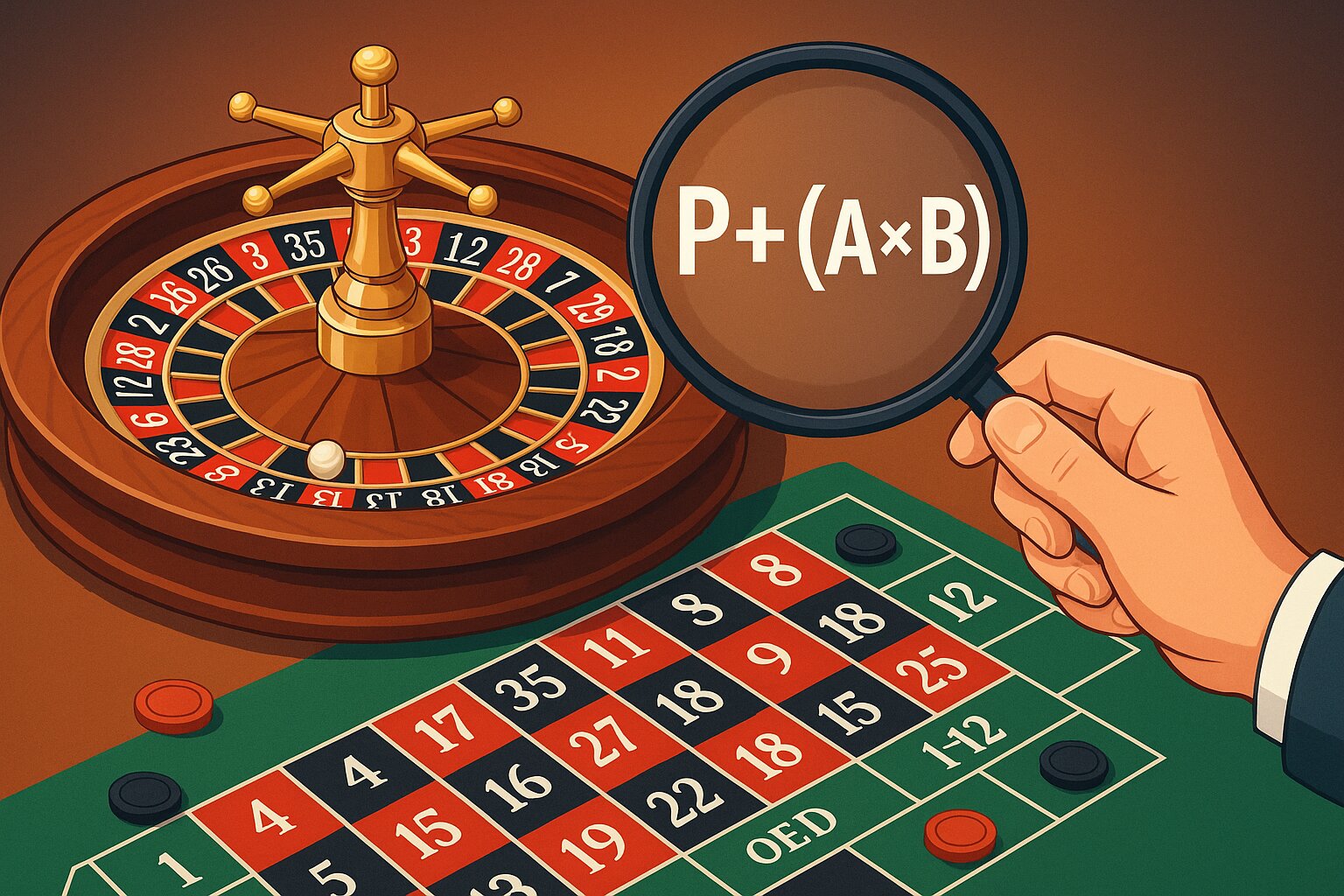
Have you ever wondered if there’s a secret formula for winning at roulette? Many players hope to find a strategy that gives them an edge at the table.
The idea of a “roulette winning formula” has fascinated casino fans for years. This article explains what those formulas actually mean, how the maths behind roulette works, and what you can realistically expect when you play.
Read on to separate fact from fiction and learn practical ways to make your sessions clearer and more controlled.
What Is the Roulette Formula & How Does It Work?
When people refer to a “roulette formula” they usually mean a betting system or set of rules intended to manage wagers. That could be a pattern of bets, instructions for increasing a stake after certain results, or mathematical ideas about which numbers to back.
Common examples include systems that double a stake after a loss, or methods that track recent outcomes and adjust bets accordingly. These approaches are about organising how you bet, not about predicting the result of a particular spin.
Every spin is independent and governed by fixed probabilities. A straight-up bet on a single number typically pays 35 to 1, while the chance of that number appearing on a European wheel is one in 37.
These figures allow players to calculate expected returns. The house edge — the small percentage the casino keeps on average — is one such result of these calculations. On European roulette the house edge is about 2.7 percent; on American roulette, which has an extra double zero, it is higher.
Because outcomes are independent, no betting pattern can remove the house edge. Mathematics helps you understand where advantage lies and how different bets compare, but it does not offer a way to beat the game over time.
The Mathematics Behind the Roulette Formula
Roulette is built on clear, unchanging maths. Each type of bet has a known payout and a known probability. For example, a straight-up bet on a single number typically pays 35 to 1, while the chance of that number appearing on a European wheel is one in 37.
These figures allow players to calculate expected returns. The house edge — the small percentage the casino keeps on average — is one such result of these calculations. On European roulette the house edge is about 2.7 percent; on American roulette, which has an extra double zero, it is higher.
Because outcomes are independent, no betting pattern can remove the house edge. Mathematics helps you understand where advantage lies and how different bets compare, but it does not offer a way to beat the game over time.
Do Roulette Formulas Guarantee Wins?
No formula guarantees a win. Systems can alter the distribution of wins and losses over short sessions, yet they do not change the long-term probabilities or the house edge.
It helps to think of a system as a tool for managing risk and playstyle. Some systems may produce frequent small wins and rare large losses, while others aim for fewer but larger payouts. Each brings different financial exposure and psychological pressure.
Understanding this distinction makes it easier to choose an approach that matches your budget and temperament rather than chasing the idea of a sure outcome.
Understanding Randomness & Probability in Roulette
Roulette operates on random, independent spins. Probability describes how likely outcomes are, but it does not dictate what will happen on any single spin.
A sequence of one colour or number does not influence the next result. The concept known as the gambler’s fallacy arises when players assume past outcomes change future chances; mathematically, they do not.
Grasping this helps set realistic expectations. You can use probability to compare bets and decide how much variance you are willing to accept, but it will not make individual results predictable.
Common Myths About Roulette Formulas
There are several persistent myths that tend to circulate among players. Common examples include:
- The belief that a system can predict the specific pocket where the ball will stop.
- The idea that tracking previous spins will reveal dependable patterns that you can exploit.
Neither is true. No strategy alters the mechanics of the wheel or the statistical independence of spins. Every spin is a separate event, and past outcomes do not change the probability of future ones.
Claims that certain sequences or betting adjustments will reliably produce profits misunderstand how probability and the odds work. Even systems that appear to win in the short term are subject to variance, and over many spins the house edge determines the long‑run expectation.
Separating these misconceptions from workable ideas helps you avoid costly mistakes and focus on sensible choices. Practical considerations include:
- Sound bet sizing and bankroll management to limit losses and play within your means.
- Table selection, for example preferring single‑zero wheels where available because they offer a lower house edge than double‑zero wheels.
- Understanding the odds and choosing bets that match your risk tolerance rather than chasing guaranteed returns.
Remember that roulette is a game of chance. Play responsibly and be aware that losses are possible and that no system can overcome the built‑in advantage the casino has.
Can You Improve Your Chances at Roulette?
While you cannot influence outcomes, you can make choices that reduce risk and make sessions more sustainable. Understanding bet probabilities lets you pick wagers that align with your appetite for volatility. For example, even-money bets offer lower variance than single-number bets, though the payouts are smaller.
Managing your bankroll is central. Decide on an amount you can afford to lose, and approach bets in a way that keeps you within that range. Avoid chasing losses; doing so typically increases exposure without improving odds.
These measures do not alter the game's mathematics but do influence how long you can play and how swings in your balance feel. That practical control often leads to a more positive experience.
Choosing the Right Table: Does It Matter?
Table choice affects the maths you face and how comfortable you are during play. European roulette, with a single zero, gives a lower house edge than American roulette, which includes a double zero. That difference changes expected returns over time.
Other considerations include table limits and specific rule variants that may affect payouts or the treatment of certain bets. Select a table that matches your preferred stake sizes and the type of bets you plan to place.
Ultimately, table choice is about aligning the game with your objectives and budget rather than finding a way to overcome the house advantage.
Risks & Responsible Play in Roulette
Roulette offers excitement, but it also carries the risk of financial loss. It is important to play within set limits and to recognise when to stop. Chasing losses or increasing stakes beyond your plan often leads to larger losses.
Practical measures can help maintain control. Set deposit and stake limits, take regular breaks, and monitor how play affects your mood and finances. Where tools to restrict play are available, they can be useful if you want to enforce boundaries.
If gambling feels problematic, confidential support is available from specialist organisations that provide advice and assistance. Keeping play proportionate to your means and monitoring behaviour are the best ways to protect yourself.
Enjoy roulette as a form of entertainment with known risks and known probabilities. By understanding the maths and managing your play, you can make clear, considered choices and end each session on terms that suit you.
**The information provided in this blog is intended for educational purposes and should not be construed as betting advice or a guarantee of success. Always gamble responsibly.