
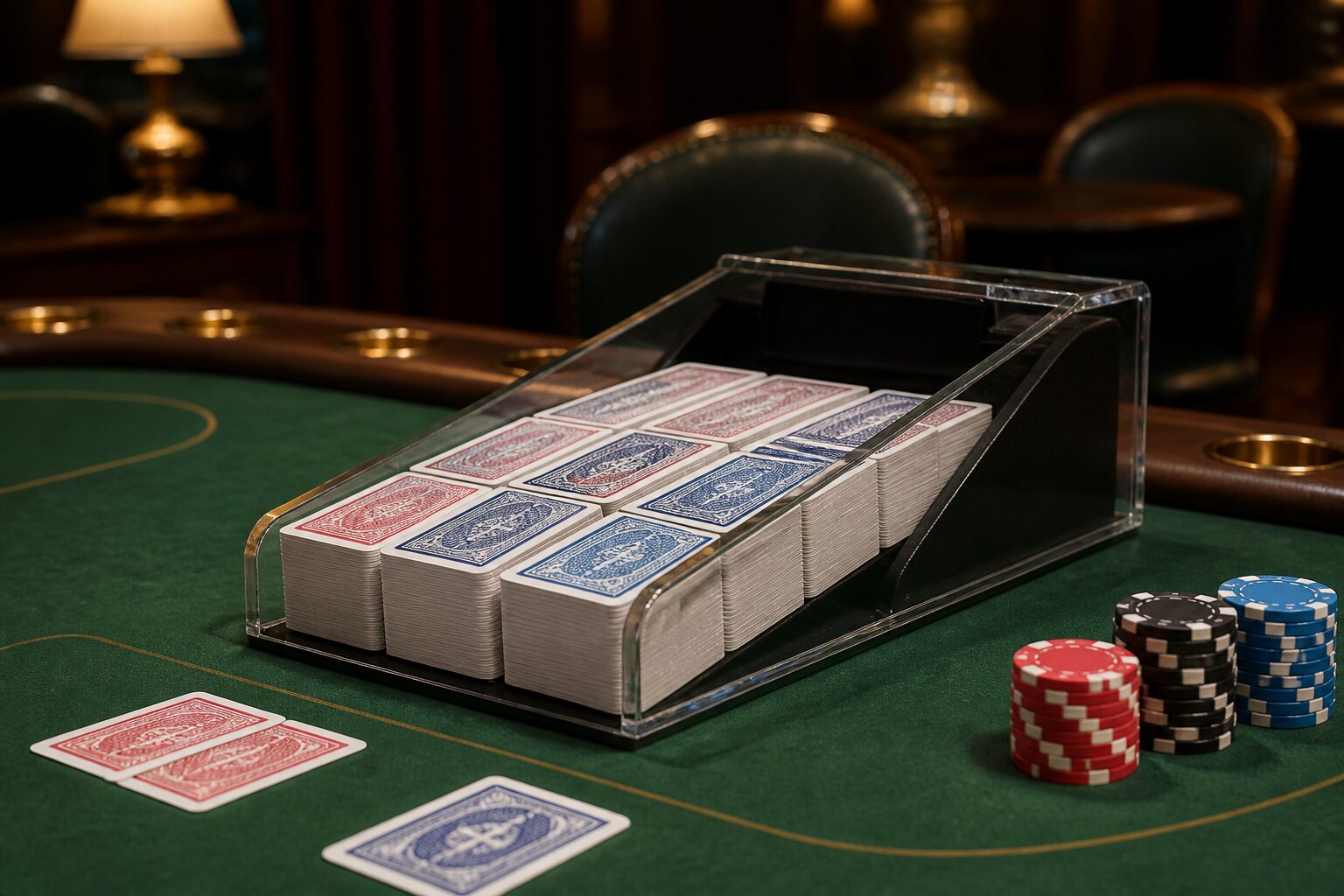
Curious about what’s really in the dealer’s hands when you sit down at a blackjack table? You’ve probably spotted those chunky, see-through boxes, called shoes, packed with deck after deck of cards. But just how many decks are being used—and does it actually affect the way the game plays?
If you’ve ever wondered why some games feel different from others, the answer often begins with the number of decks inside the shoe. Understanding that setup will help you choose a table that suits your preferences and expectations. Read on to learn what the shoe does, how deck count changes the game, and what to look for before you play.
What Is a Blackjack Shoe?
A blackjack shoe is a simple device used by the dealer to hold multiple decks of cards. Typically made from clear plastic, it sits within easy reach and allows the dealer to draw cards steadily without reshuffling after every hand.
The shoe speeds up dealing, reduces handling errors and limits the chance of tampering, which keeps gameplay running smoothly. It’s also used in live online dealer games where several decks are combined and dealt at the table.
In short, the shoe organises multiple decks so the dealer can deal efficiently and consistently. That basic role underpins several of the differences you’ll notice between single-deck and multi-deck games.
How Many Decks Are in a Standard Blackjack Shoe?
A standard shoe most commonly holds six to eight decks of cards. That configuration is widely used because it balances operational convenience with game integrity.
Fewer decks do appear in some private or promotional games, and single-deck or double-deck tables exist too, but the six- and eight-deck shoes are the norm you’ll encounter at many tables and in most live dealer setups. The shoe’s capacity determines how many hands can be dealt between full shuffles, which affects pace and how long a dealt sequence will run before cards are replaced.
If you see a larger-looking shoe, it’s often because more decks are in use; a smaller shoe typically means fewer decks. If you want absolute certainty, check the table’s posted rules or ask the dealer.
Why Do Casinos Use Multiple Decks in Blackjack?
Casinos use multiple decks for a few practical reasons. Combining decks into a shoe makes dealing faster and reduces the frequency of shuffles, which keeps play moving without repeated interruptions. It also adds a level of operational security by making precise prediction of remaining cards more difficult.
From a house standpoint, adding decks slightly changes the mathematical edge and how certain hands behave; this is a normal part of game design rather than an attempt to disadvantage players unfairly. Rules and procedures are in place to ensure games are regulated and that play remains consistent for everyone.
Using more decks also reduces the number of times the deck contents are exposed to handling, which helps maintain the integrity of the shuffle and the order of cards between shuffles.
Does the Number of Decks Affect the Game?
Yes — the number of decks does influence some aspects of play, though the effects are subtle. As decks are added, the probability of particular card sequences shifts, which can change the frequency of certain outcomes like blackjacks or the dealer making particular totals. These differences are measurable and factored into the rules that games use.
For players, the practical consequences are usually modest: strategy adjustments can be small but meaningful in longer sessions, and some side bets or rule variants interact differently with multi-deck games. Rather than being a decisive factor on its own, deck count is one variable among several — rules, table limits and the dealer’s standing rules are all part of the overall picture.
If you prefer simpler strategic choices, tables with fewer decks tend to present slightly more straightforward probabilities. If you’re comparing games, look at the full set of rules and payouts alongside deck count to get a clearer sense of how the game will play out.
How Can You Tell How Many Decks Are in Use?
It’s straightforward to find out how many decks a table is using. Casinos typically display the number of decks on the table rules or on a nearby sign, and live online games list this information in the game details.
If that information isn’t obvious, a quick question to the dealer or floor staff will clarify the setup. In live online settings, the rules or information tab will usually state the deck count and whether the shoe is shuffled by hand or with an automatic shuffler.
Visual cues can help too: a physically larger shoe typically contains more decks, while a slim shoe usually holds fewer. Still, the most reliable method is to check the posted rules or ask before you sit down.
Common Myths About Blackjack Shoes and Deck Numbers
A few persistent myths surround shoes and deck numbers. One is that knowing the deck count guarantees a player advantage; in practice, deck count alone doesn’t create a reliable edge during standard play. Another myth is that additional decks are used to “cheat” players — in reality, multiple decks are a practical choice to maintain consistent play and security.
Some players believe that moving between tables to find a different deck count will significantly alter their chances of success. While deck count does affect probabilities slightly, it does not override the broader set of rules that define each game. The best approach is to look at rules, payouts and table limits together rather than fixating on deck number by itself.
Choosing the Right Blackjack Table for You
Finding the right table comes down to matching the game’s characteristics to your preferences and budget. Think about bet limits first — choose tables where the minimums and maximums fit how much you want to wager.
Also look at the rule set: small variations such as whether the dealer hits or stands on certain totals, payout for blackjack, and the availability of side bets will change how the game plays and how you might approach it. If you prefer simpler odds and fewer rule complexities, tables with fewer decks and standard payouts tend to be easier to follow.
Finally, consider how long you want to play and how much interaction you enjoy. Some tables move briskly and are more hands-on, while others offer a steadier, slower pace. Pick a table that matches how you like to spend your time and stick to the betting range that feels comfortable.
If you’d like, browse our table listings to compare limits, rules and deck counts so you can pick a game that suits your style and budget.
**The information provided in this blog is intended for educational purposes and should not be construed as betting advice or a guarantee of success. Always gamble responsibly.